

For many Indian mid-market and enterprise leaders, the ERP discussion frequently hits a familiar operational wall: “ECC chal raha hai, toh upgrade ki kya jaldi hai?”
When core financial reporting appears to function, plants output daily shipments, and month-end closes eventually get patched together, migrating to SAP S/4HANA Cloud can easily be misdiagnosed as an expensive IT infrastructure chore.
Evaluating modern ERP through the lens of basic operational uptime is a strategic blind spot. In an economic environment defined by tight working capital cycles, multi-tier GST compliance, complex manufacturing footprints, and dynamic input costs, legacy ERP architectures fail silently. They do not fail by crashing; they fail by creating latency, forcing teams into shadow Excel workbooks, delaying executive decision-making, and leaving leadership with outdated rear-view metrics.
Moving to SAP S/4HANA Cloud is not a database lift-and-shift or a simple technical upgrade. It is an operational transformation that replaces batch-processing delays with unified, live intelligence.
1. What Really Breaks vs. What Transforms: The Practical Reality
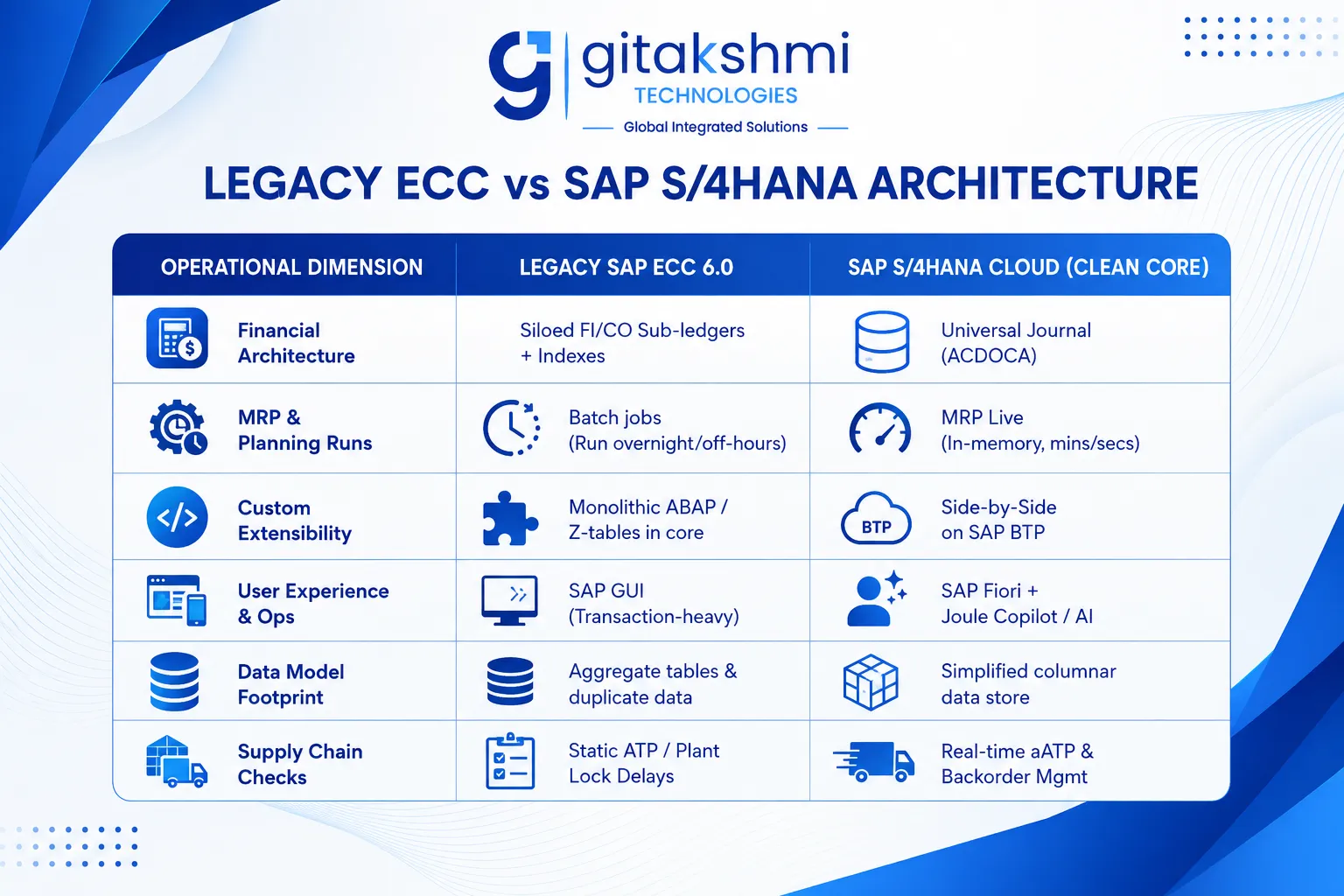
Industry literature frequently focuses on marketing jargon while glossing over day-to-day functional mechanics. In practice, operational transformation concentrates across four fundamental pillars.
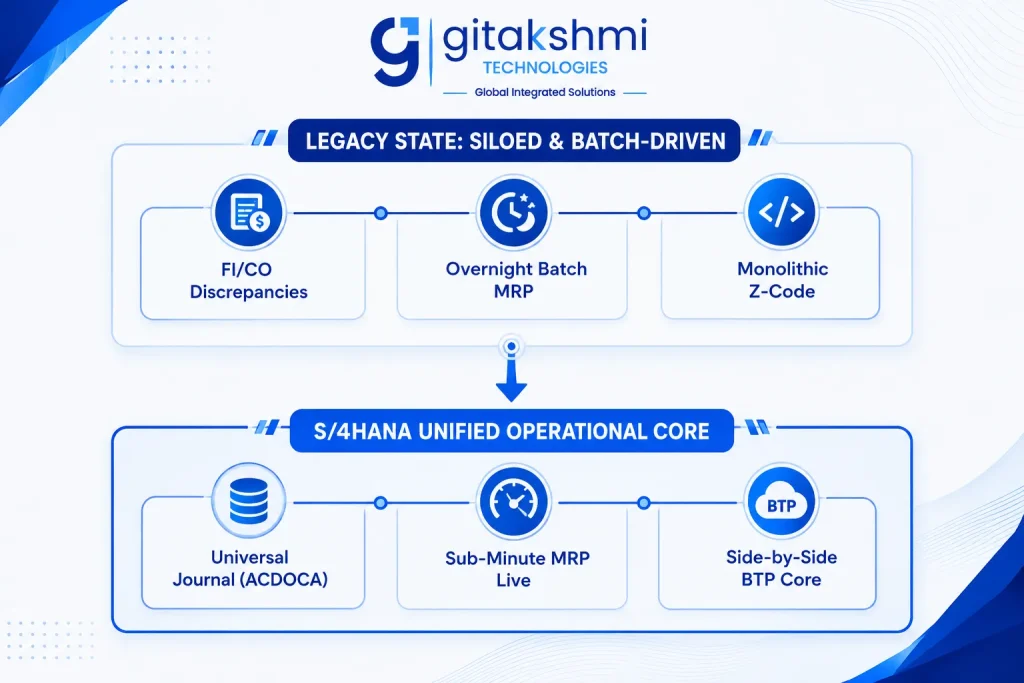
Pillar 1: Financial Architecture & The Universal Journal (ACDOCA)
In legacy SAP ECC, the General Ledger (FI-GL), Accounts Payable (FI-AP), Accounts Receivable (FI-AR), Asset Accounting (FI-AA), and Controlling (CO) reside in fundamentally separate tables:
- BKPF / BSEG for standard accounting documents.
- COEP for line-item controlling.
- ANEP for asset line items.
- Multiple secondary index tables (BSIS, BSAS, BSIK, BSAK) and aggregate tables (GLT0, KNC1, LFC1).
Running financial reconciliations at month-end under this legacy model requires manual journal entries, cross-ledger settlement runs, and substantial administrative effort to ensure managerial controlling balances with the audited statutory ledger.
The S/4HANA Transformation:
S/4HANA eliminates aggregate and secondary index tables, collapsing financial accounting and managerial cost accounting into a single source of financial truth: the Universal Journal (ACDOCA).
Every operational transaction writes to a single record with multi-dimensional coding blocks (Cost Center, Profit Center, Segment, Functional Area, WBS Element, and Custom Dimensions).
- Cost center allocations and profitability insights update instantaneously at transaction time.
- P&L and Balance Sheet impacts are transparent down to the individual transaction line.
- Intercompany reconciliations occur continuously instead of during a condensed month-end close window.
Pillar 2: Supply Chain Velocity & Real-Time Material Planning (MRP Live)
Traditional Material Requirements Planning (MD01 or MD02) in SAP ECC is computationally heavy. Legacy architectures calculate dependencies, bill-of-materials (BOM) explosions, open purchase orders, safety stock levels, and demand signals sequentially by extracting data from disk storage into the application server. Consequently, enterprises run MRP as an overnight batch job.
If an unexpected production stoppage, supplier delay, or rush sales order occurs at 10:00 AM, plant managers must either wait until the next day’s batch run or rely on offline calculations to balance inventory.
The S/4HANA Transformation:
Using the in-memory engine of the SAP HANA database, MRP Live (MD01N) calculates material requirements directly within the database layer using parallel processing threads:
- Planning run cycles drop from multiple hours to single-digit minutes.
- Multi-plant networks can run MRP dynamically multiple times per shift.
- Planners immediately see the downstream impacts of material bottlenecks, transit delays, and cancelled stock allocations, enabling rapid procurement adjustments.
Pillar 3: Sourcing, Procurement, and Operational Working Capital
Legacy procurement depends on batch inventory valuation and delayed Goods Receipt/Invoice Receipt (GR/IR) clearing. When procurement teams manage supplier pricing variations, freight handling markups, and dynamic vendor terms manually, accounts payable reconciliation lags behind physical stock movements.
The S/4HANA Transformation:
S/4HANA embeds operational sourcing directly into transactional workflows. Real-time material ledger valuations reflect exact moving-average or standard costs across multi-currency and multi-tax scenarios instantly. Purchase order commitments reflect against budget allocations in real time, preventing unapproved procurement leakage before orders reach suppliers.
Pillar 4: Sales, Order Fulfillment, and Real-Time Availability (aATP)
In classic ECC systems, standard Available-to-Promise (ATP) checks evaluate stock at the plant or storage location level through lock-based table queries. When high-volume orders land concurrently, lock contention slows down order processing, and businesses often over-commit inventory due to stale allocation records.
The S/4HANA Transformation:
Advanced Available-to-Promise (aATP) provides dynamic product allocation, backorder processing with release-for-delivery prioritization, and alternative plant sourcing calculations in real time. Sales organizations can confirm hard delivery timelines with end-to-end visibility into current production runs and inbound logistics.
2. Choosing the Right Migration Strategy
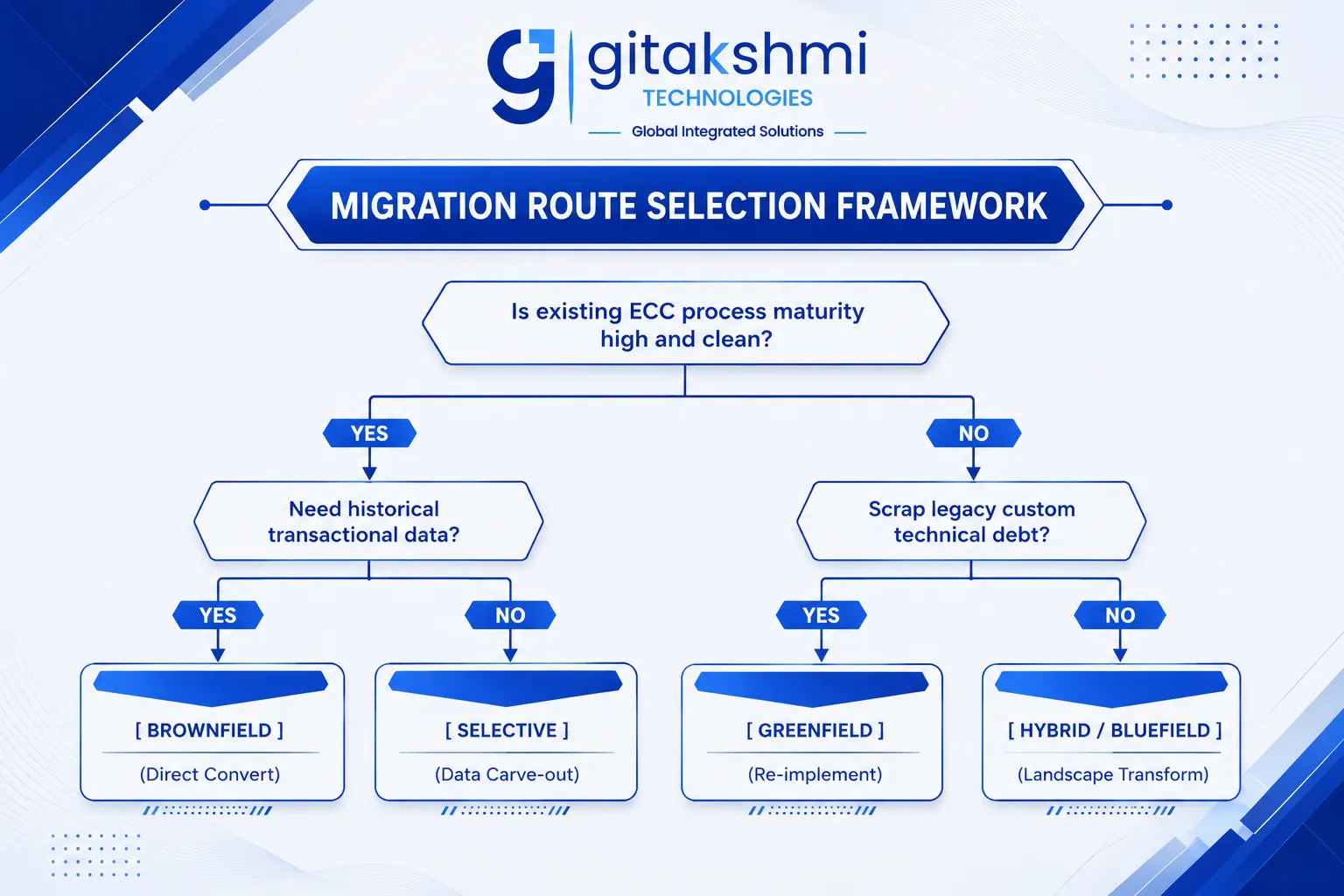
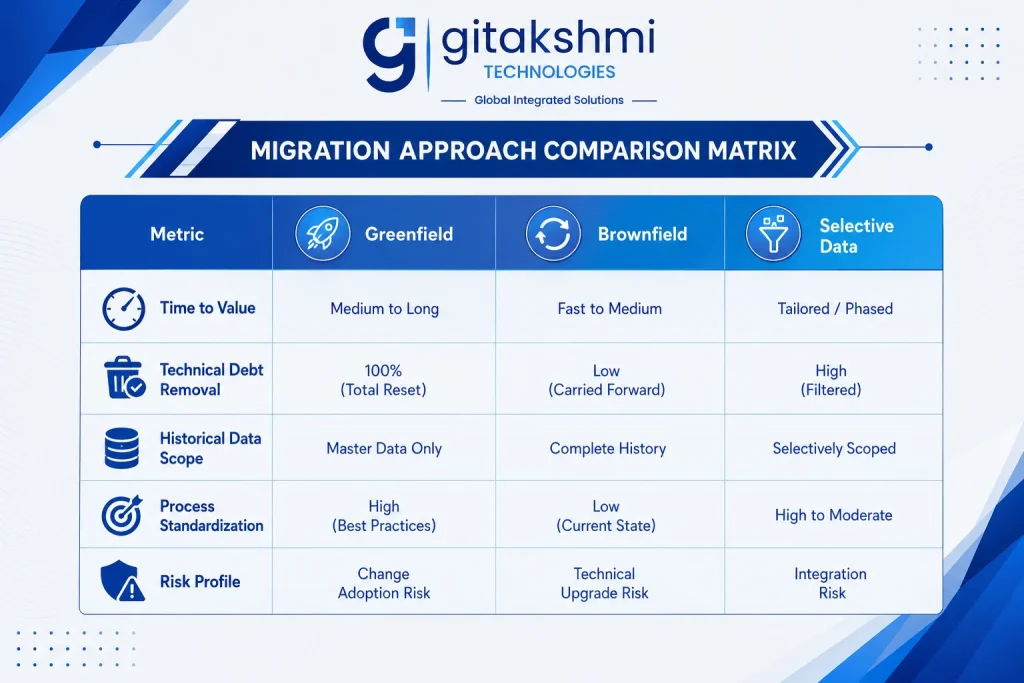
Choosing a migration path is an architectural and organizational decision that dictates cost structures, data integrity, and business downtime.
Greenfield (New Implementation)
A Greenfield implementation rebuilds the enterprise ERP environment from the ground up on SAP S/4HANA Cloud, adopting standardized SAP Best Practices.
- Best Suited For: Organizations burdened by decades of unstructured customizations (Z-transactions), fragmented enterprise structures, poor historical master data quality, or businesses undertaking wholesale business model transformations.
- Core Advantage: Complete elimination of technical debt; full adoption of modern standard business processes; out-of-the-box readiness for rapid innovation cycles and SaaS upgrades.
- Trade-Offs: Requires explicit change management to shift teams away from legacy custom behaviors; historical transaction data must be archived and accessed outside the primary live instance.
Brownfield (System Conversion)
A Brownfield migration converts the existing SAP ECC environment directly into SAP S/4HANA in a single technical and functional upgrade cycle.
- Best Suited For: Enterprises whose current business processes match operational needs, whose custom ABAP codebase is well-managed and documented, and who require historical transactional data on hand for continuous audits.
- Core Advantage: Lower business disruption; reduced functional retraining requirements; preservation of core configurations, document history, and existing integrations.
- Trade-Offs: Carries forward historical architectural inefficiencies; requires exhaustive pre-checks, custom code remediation, and extensive regression testing.
Selective Data Transition (Hybrid / Landscape Transformation)
A Selective Data Transition uses specialized data-migration software to combine the clean architectural slate of a Greenfield implementation with the selective historical retention of a Brownfield path.
- Best Suited For: Large conglomerates, diversified business houses, or multi-entity organizations carving out specific business units, consolidating multiple ECC instances, or migrating specific company codes step-by-step.
- Core Advantage: Allows granular transfer of open items, active master data, and selected years of historical ledgers without dragging legacy system baggage along.
- Trade-Offs: Higher initial planning complexity; requires specialized data migration tooling and specialized implementation expertise.
3. The Modern Tech Core: Clean Core, SAP BTP & Agentic AI
The most significant risk to long-term ERP agility is custom code bloat. In legacy environments, ABAP developers modified standard SAP core tables and functions directly. Over a decade, this creates an inflexible system where minor support packages require months of regression testing.
The Clean Core Imperative
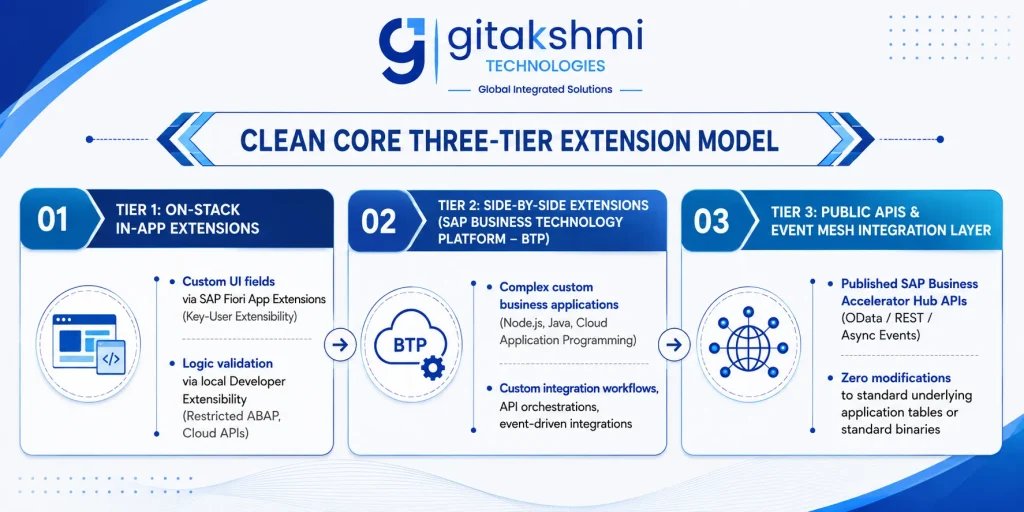
A Clean Core strategy decouples business extensions from the baseline ERP code:
- Zero Core Modifications: Core software components remain untouched.
- Standard Cloud APIs: System interfaces connect exclusively through stable, upgrade-safe APIs cataloged on the SAP Business Accelerator Hub.
- Side-by-Side Development on SAP BTP: Custom business logic, portal integrations, third-party logistics connectivity, and specialized industry features run on SAP Business Technology Platform (BTP). Upgrading the primary ERP engine then takes days or weeks rather than months, with zero impact on custom extensions.
Agentic AI & Joule Integration
Modern S/4HANA Cloud systems incorporate native artificial intelligence directly into the business flow rather than treating AI as a disconnected experimental tool.
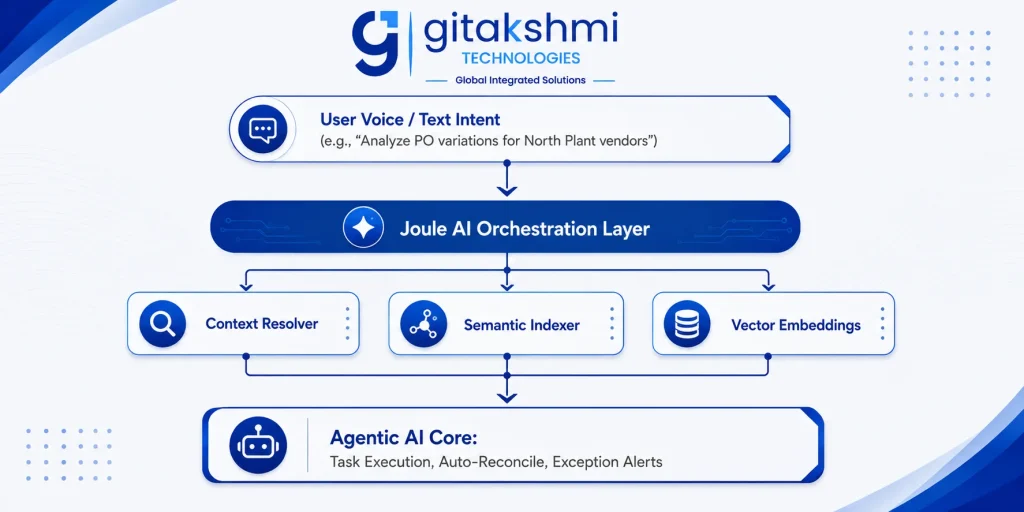
Contextual Conversational Interactions: Business users query operational KPIs directly through Joule using natural language: “Identify open purchase orders at risk of delivery delays for the automotive plant.”
- Agentic Financial Reconciliation: Automated algorithms cross-reference incoming unstructured payment advices against disputed line items in accounts receivable, resolving routine clearing decisions automatically.
- Predictive Exception Resolution: Built-in machine learning models flag supply chain stock-outs, transport bottlenecks, and unbilled deliveries before they impact the general ledger.
4. The Post Go-Live Reality: Surviving & Winning Day 2
Organizations often treat the “Go-Live” cutover date as the finish line. In reality, Go-Live is merely the start of operational value extraction.
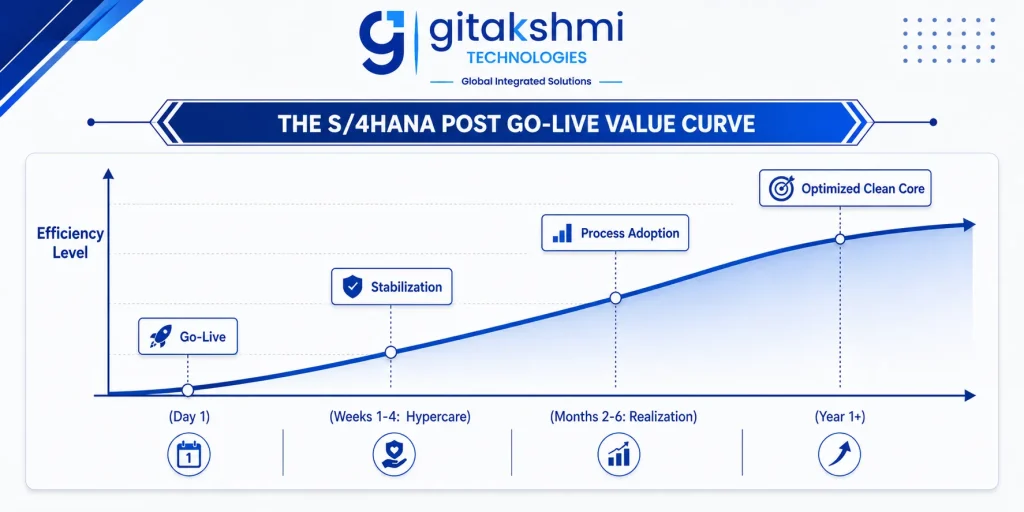
The 4 Realities to Prepare For
Reality 1: Master Data Hygiene Determines System Uptime
In legacy systems, loose validation routines allowed missing tax indicators, unassigned vendor reconciliation accounts, or incomplete commodity codes to pass through. S/4HANA’s real-time engines halt downstream transactions instantly if master data is inconsistent.
- Operational Response: Stand up rigorous Data Governance (e.g., SAP Master Data Governance or strict approval matrices) before processing live transactions.
Reality 2: Eliminating the “Shadow Excel” Culture
When end-users encounter modern SAP Fiori interfaces, their immediate instinct is often to download raw tabular data and return to their legacy offline spreadsheets.
- Operational Response: Transition functional leads away from flat data dumps. Configure role-based Fiori analytical cards, interactive drill-downs, and real-time alerts tailored directly to daily departmental operational targets.
Reality 3: Disciplined Change Governance
Once live, every functional unit will request new custom fields, custom screens, and unique reports. Uncontrolled customizations will steadily erode the Clean Core strategy.
- Operational Response: Establish an architectural review board. Every enhancement request must follow an API-first framework and be built side-by-side on SAP BTP rather than inside the core system.
Reality 4: Integration Pipeline Auditing
Real-time ERP architectures require real-time interface operations. Unmonitored API errors across e-Invoicing portals, GSTN connectors, banking APIs, customer storefronts, and third-party logistics providers disrupt daily business.
- Operational Response: Deploy unified cloud monitoring systems (such as SAP Cloud ALM) to track API payload performance, authorization expirations, and interface exceptions proactively.
5. Enterprise Readiness Checklist
Before committing resources to an SAP S/4HANA transformation program, cross-functional leadership must evaluate organizational maturity against four core criteria:
1. DATA ASSET MATURITY
• Has legacy master data (Material Master, Business Partner, Chart of Accounts) been deduped and profiled?
• Have transactional data archival strategies been defined for inactive company codes and aged line items?
2. CUSTOM TECHNICAL DEBT AUDIT
• Has an SAP Readiness Check been executed across custom code (Z and Y programs)?
• Are redundant customizations and dead code paths slated for retirement rather than automatic migration?
3. CROSS-FUNCTIONAL PROCESS OWNERSHIP
• Are functional heads (CFO, VP Supply Chain, Head of Manufacturing) accountable for process redesign?
• Has the business committed to adopting standard SAP Best Practices instead of recreating legacy workflows?
4. CHANGE MANAGEMENT & ENABLEMENT
• Is there a clear training roadmap to shift operational teams from classic SAP GUI to web-based SAP Fiori?
• Are digital adoption programs in place to train teams on real-time operational reporting tools?
Frequently Asked Questions (FAQ)
What is the primary difference between SAP ECC and SAP S/4HANA?
SAP ECC runs on third-party relational databases with separated sub-ledgers and reliance on batch processing. SAP S/4HANA runs exclusively on the high-performance, in-memory SAP HANA database. It unifies finance into a single Universal Journal (ACDOCA), processes planning logic via sub-minute MRP Live, and uses modern, role-based SAP Fiori interfaces and embedded AI agents instead of transactional menu screens.
How does the Universal Journal (ACDOCA) improve financial operations?
The Universal Journal brings Financial Accounting (FI) and Controlling (CO) line items together into a single table. It eliminates separate balance and secondary index tables, removes the need for month-end FI-CO reconciliations, enables instant multi-dimensional profitability reporting, and provides full line-item auditability from financial statements down to operational source documents.
What is a Clean Core strategy, and why is it essential?
A Clean Core strategy keeps the core ERP code strictly unmodified by building custom logic, integrations, and extensions side-by-side on the SAP Business Technology Platform (BTP) using standard public APIs. This ensures that routine system updates, cloud feature upgrades, and security patches can be deployed quickly without breaking customizations or requiring months of regression testing.
How does SAP Joule differ from standard enterprise chatbots?
Unlike generic chatbots that simply search documentation, SAP Joule is an Agentic AI copilot. It understands underlying business context, interfaces securely with core enterprise tables, identifies operational anomalies, and executes end-to-end multi-step tasks—such as matching incoming bank remittance files with open customer invoices.
What is the official deadline for migrating from SAP ECC to S/4HANA?
Mainstream support for core SAP ECC 6.0 releases concludes at the end of 2027, with extended maintenance options running through 2030. Starting migration planning early prevents project crunches and ensures sufficient time for business process optimization.
Why is Customer-Vendor Integration (CVI) mandatory in S/4HANA?
S/4HANA replaces separate legacy customer and vendor master records with the unified Business Partner (BP) data model. CVI consolidates duplicate legal entities into a single identifier with multiple operational roles, enabling unified credit checks, offset reconciliations, and streamlined compliance.
Can we run SAP S/4HANA using the classic SAP GUI interface?
While SAP GUI remains accessible for specific backend configuration and administration tasks in Private Cloud or On-Premise deployments, core modern features—including interactive analytical dashboards, MRP Live exception workspaces, and SAP Joule AI copilots—are designed exclusively for and accessible through the SAP Fiori experience.
Greenfield vs. Brownfield: How should an enterprise choose?
Choose Greenfield if the legacy system carries heavy custom technical debt, outdated process designs, and poor master data that would benefit from starting fresh with standard SAP Best Practices. Choose Brownfield if existing business processes are mature, the custom code footprint is well-maintained, and keeping complete historical transactional data within the active system is a business requirement.
An enterprise ERP migration is ultimately defined by organizational agility: the speed of financial closing, the clarity of working capital, and the ability to pivot supply chains under changing market conditions. Approached with a Clean Core architecture, clear master data governance, and active business leadership, SAP S/4HANA shifts the ERP from an administrative database into an operational platform built for sustained scale.