
The Big Idea: What If Your Business Could Actually Think Ahead?
Every business runs on questions.
A warehouse manager asks why a shipment is late. A finance head asks why operating
expenses spiked by 14% this quarter. A sales director asks which accounts are likely to renew and which are silently slipping away.
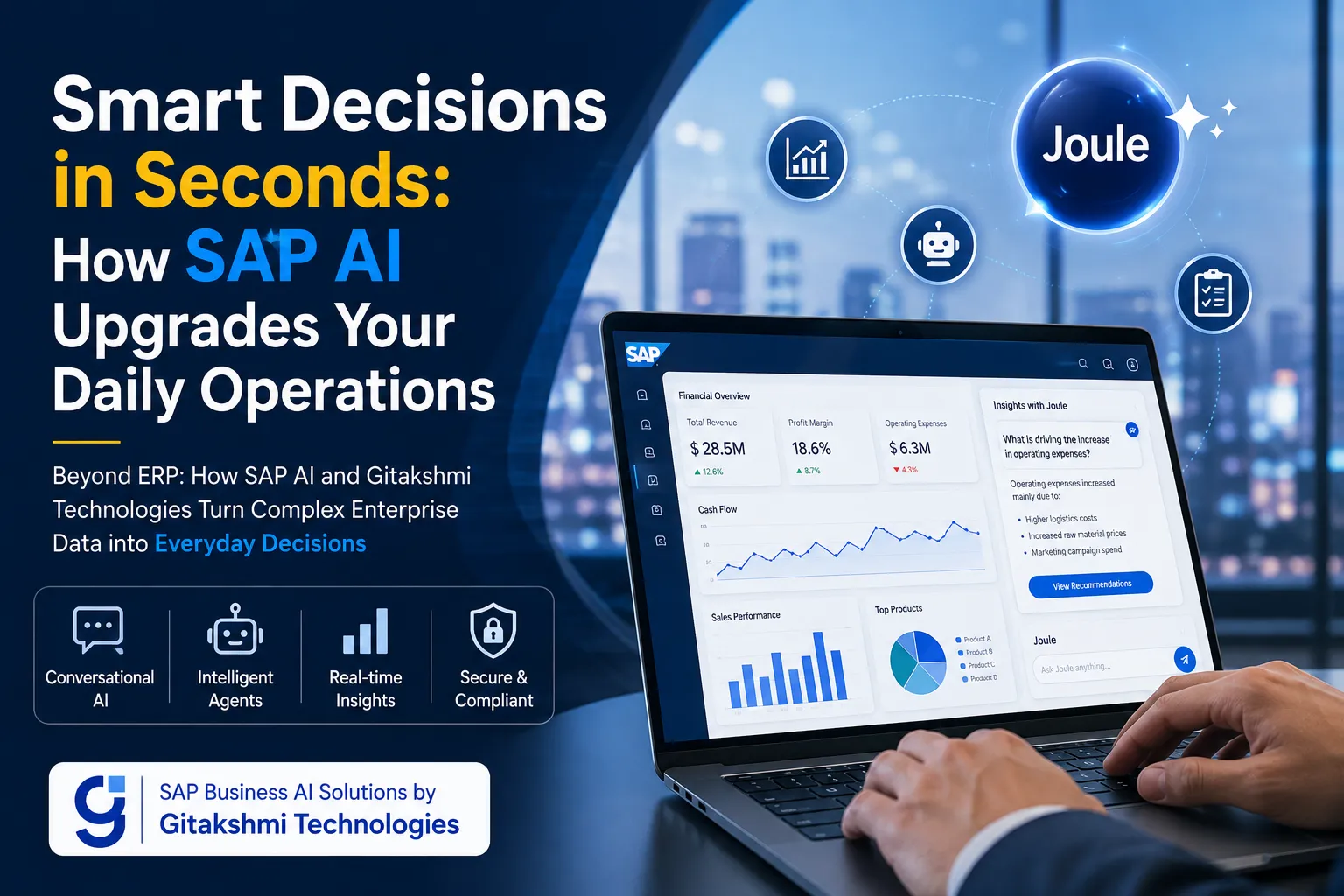
With the launch of dedicated SAP AI solutions by Gitakshmi Technologies, businesses of all sizes can move away from static record-keeping and step into an intelligent enterprise environment where data directly drives action.
Market Reality: Why Was SAP AI Created in the First Place?
To understand why SAP AI matters, we have to look at the history of enterprise software and
the core problem it created.
For over thirty years, ERP (Enterprise Resource Planning) software served one central
purpose: to record transactions. It tracked invoices, recorded employee attendance, logged
material movements, and stored customer profiles.
ERP systems solved the problem of organizing company records, but they created a brand-
new bottleneck: information overload.
Modern companies do not suffer from a lack of data. They have millions of rows of data
sitting across finance, supply chains, sales pipelines, and HR tools. The real bottleneck is
human processing speed.
When modern generative AI emerged, many businesses tried to bridge this gap using public,
standalone AI chatbots. However, these tools failed in real business settings because of three
fundamental gaps:
- Zero Business Context: A generic AI tool knows what an invoice is in theory, but it
does not know your company’s negotiated payment terms, your specific vendor risk
scores, or your internal approval hierarchies. - Data Security & Privacy Risks: Uploading confidential financial ledgers or proprietary
customer contracts into public models creates severe security and regulatory
liabilities. - No Direct Action Layer: A regular chatbot can write an answer, but it cannot open
your ERP, check real-time inventory, re-route a delivery, or trigger an accounting
journal entry.
SAP built SAP Business AI specifically to solve these three structural flaws. Instead of
bringing your business data to an outside chatbot, SAP embedded intelligent models directly
inside the workflows where your daily business already happens.
What Exactly Is SAP AI and How Does It Work?
SAP AI is not a single product or a standalone software download. It is a comprehensive
intelligence layer built directly into the entire SAP product suite, including - SAP S/4HANA Solutions/ SAP SuccessFactors, SAP Ariba, SAP Concur , and SAP Customer Experience.
At its core, the SAP AI architecture consists of four distinct, coordinated layers:
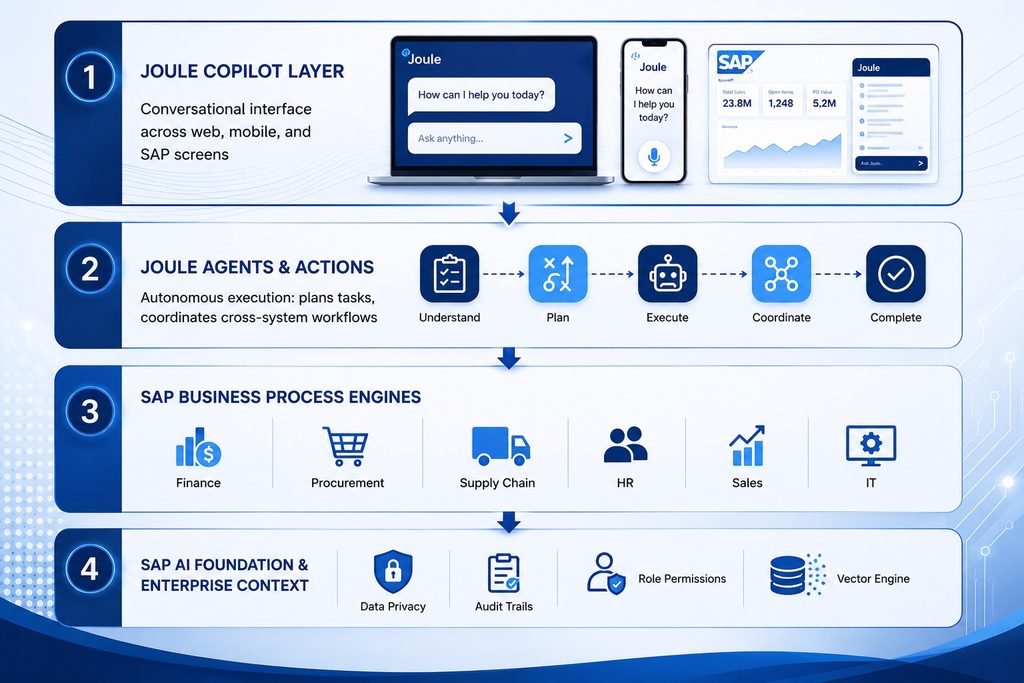
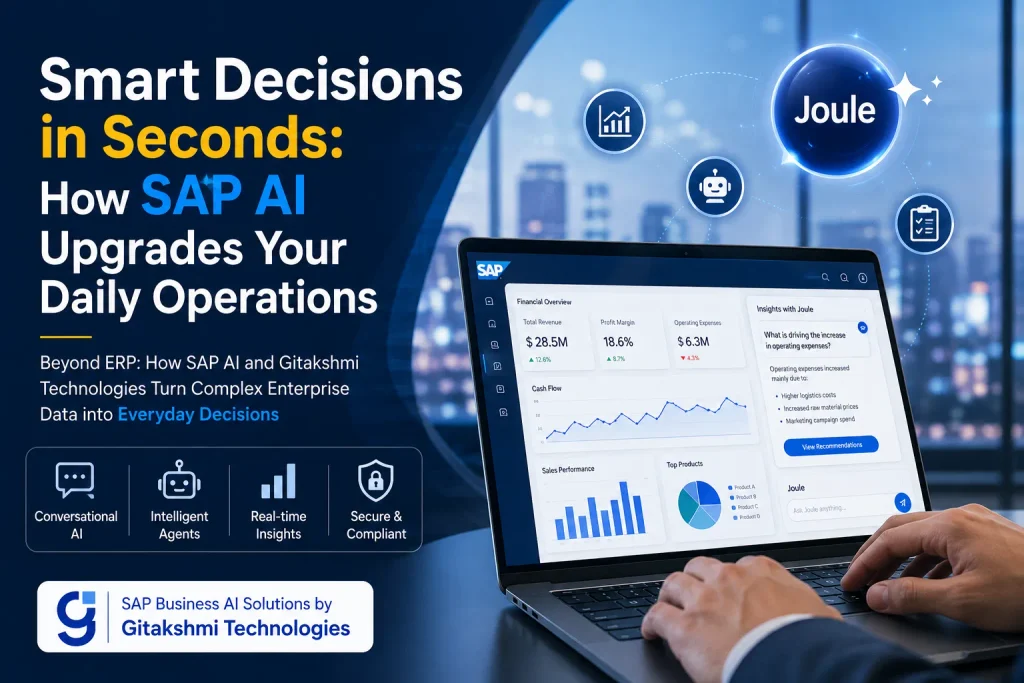
- Joule: The Natural Language Copilot
Joule is the conversational front-end of SAP AI. It lives directly inside your SAP interface.
Instead of clicking through five navigation menus, memorizing complex transaction codes, or
running separate queries, employees simply tell Joule what they need in conversational
language. - Joule Agents: From Answering to Executing
While basic AI only responds to text prompts, Joule Agents are goal-oriented digital workers.
You can assign an objective—such as “Resolve the raw material bottleneck for Plant 2″—and
the agent will inspect supplier catalogs, identify available stock from alternative vendors,
check shipping lead times, and present a pre-filled purchase order for your sign-off. - Business Context Engine
Context is what makes SAP AI reliable. If a purchase order is delayed by four days, the system
does not view it merely as a changed date on a screen. It immediately recognizes that this
delay impacts an active manufacturing line, delays delivery to a Tier-1 client, and risks an SLA
penalty. It connects every isolated data point to the larger operational picture. - SAP AI Foundation: Security and Governance
Enterprise operations demand strict compliance. The SAP AI Foundation ensures that every
query, prompt, and automated action adheres to strict role-based access controls. A
warehouse assistant cannot see executive payroll records, and sensitive company data is
never used to train external public models.
The Key Difference: Traditional Enterprise Systems vs. SAP AI
| Feature/Capability | Traditional Enterprise ERP | The SAP AI-Powered Approach |
| User Interaction | Complex menu trees and specific transaction codes | Natural language conversational prompts via Joule |
| Data Visibility | Static historical dashboards and backward-looking reports | Dynamic, context-aware analysis with predictive alerts |
| Handling Tasks | Manual data entry across multiple departmental screens | Autonomous multi-step task execution via Joule Agents |
| Workflow Automation | Rigid, rule-based triggers (If Condition X → Do Y) | Adaptive workflows that handle exceptions and process nuances |
| Decision Support | Relies entirely on manual human calculations | Delivers instant recommendations backed by live data |
| User Onboarding | Weeks of dedicated software navigation training | Minimal training required; users interact in plain language |
Real-World Impact: How SAP AI Transforms Core Departments
SAP AI is not restricted to technical teams. It delivers practical value across every major
business unit.
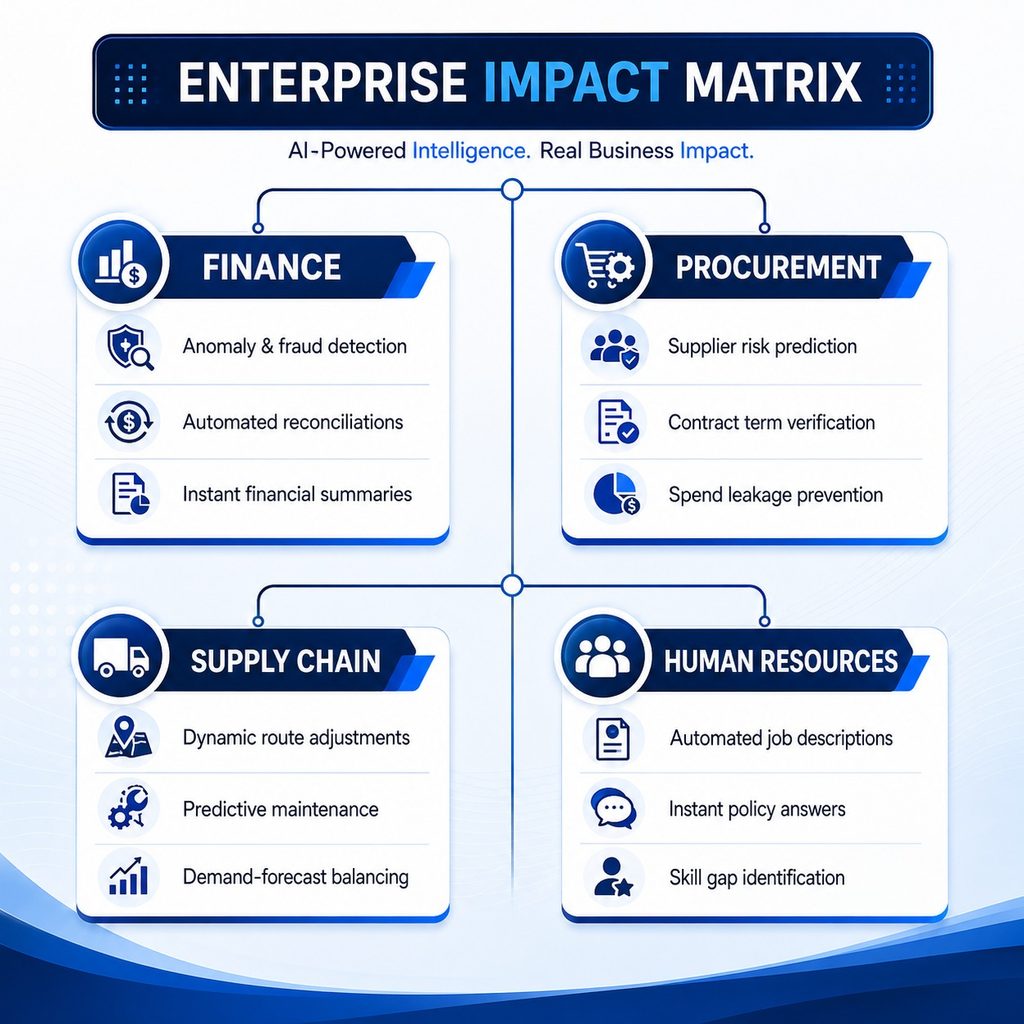
- Finance and Accounting
- Automated Reconciliation: Automatically matches bank statements, incoming
customer payments, and open invoices, even when transaction references are
incomplete or misspelled. - Anomaly & Fraud Detection: Scans thousands of journal entries in real time to
highlight unusual payment patterns, duplicate invoices, or unauthorized balance
changes before payments execute. - Executive Summaries: Generates instant quarterly performance write-ups comparing
actual spend against budgets with zero manual data compilation.
- Supply Chain and Inventory Management
- Predictive Stock Replenishment: Balances reorder points by evaluating live sales
velocity, seasonal trends, and supplier lead-time changes. - Disruption Mitigation: If a shipping route faces weather or port delays, the system
identifies the at-risk customer orders and suggests alternate sourcing locations. - Asset Maintenance: Analyzes IoT sensor readings from plant machinery to predict
part failures before production lines unexpectedly shut down.
- Procurement and Vendor Management
- Contract Compliance: Reads vendor contracts and compares inbound invoices
against agreed volume discount tiers to catch overbilling automatically. - Supplier Risk Scoring: Gathers external market intelligence and internal supplier
performance history to rate delivery reliability before you issue major purchase
orders. - Guided Buying: Helps non-procurement employees order goods and services within
corporate policy limits using conversational prompts.
- Human Resources and Talent Management
- Instant Employee Self-Service: Answers common employee questions about leave
policies, insurance coverage, and compensation structures through conversational
chat. - Job Role Creation: Drafts clear, inclusive job descriptions aligned with internal
organization standards and market benchmarks. - Skills Gap Mapping: Analyzes existing team skill sets against upcoming project
requirements to suggest personalized training and upskilling pathways.
- Sales and Customer Relationship Management
- Lead Prioritization: Evaluates customer engagement history, order frequency, and
market signals to score leads with the highest conversion probability. - Quote Acceleration: Auto-populates complex, multi-item enterprise price quotes
based on pre-approved discount structures and real-time inventory availability. - Customer Retention Warnings: Identifies accounts showing declining order volumes
or unresolved support tickets so sales managers can intervene early. - Cross-Industry Applications: Where SAP AI Drives Value
SAP AI adapts to the unique operational demands of diverse industries.
Manufacturing - Coordinates production schedules across multiple assembly lines based on raw
material arrival times. - Reduces scrap and rework rates by flagging quality variations early in the production
cycle. - Retail and E-Commerce
- Optimizes regional warehouse inventory levels based on shifting local purchasing
trends. - Automates supplier communications for fast-moving consumer goods to prevent
stockouts during promotional spikes.
Construction and Real Estate - Tracks material deliveries, subcontractor payment milestones, and equipment
utilization across active job sites. - Provides predictive cost-to-complete forecasts to keep large infrastructure projects
within budget.
Healthcare and Pharmaceuticals - Improves regulatory compliance and audit trails across cold-chain logistics and
temperature-sensitive shipments. - Automates medical supply procurement based on historical patient intake trends and
department consumption.
Professional Services - Streamlines consultant project allocations and resource planning to maximize billable
utilization. - Automates time-sheet tracking, expense reviews, and client billing cycles.
Who Benefits Most from SAP AI?
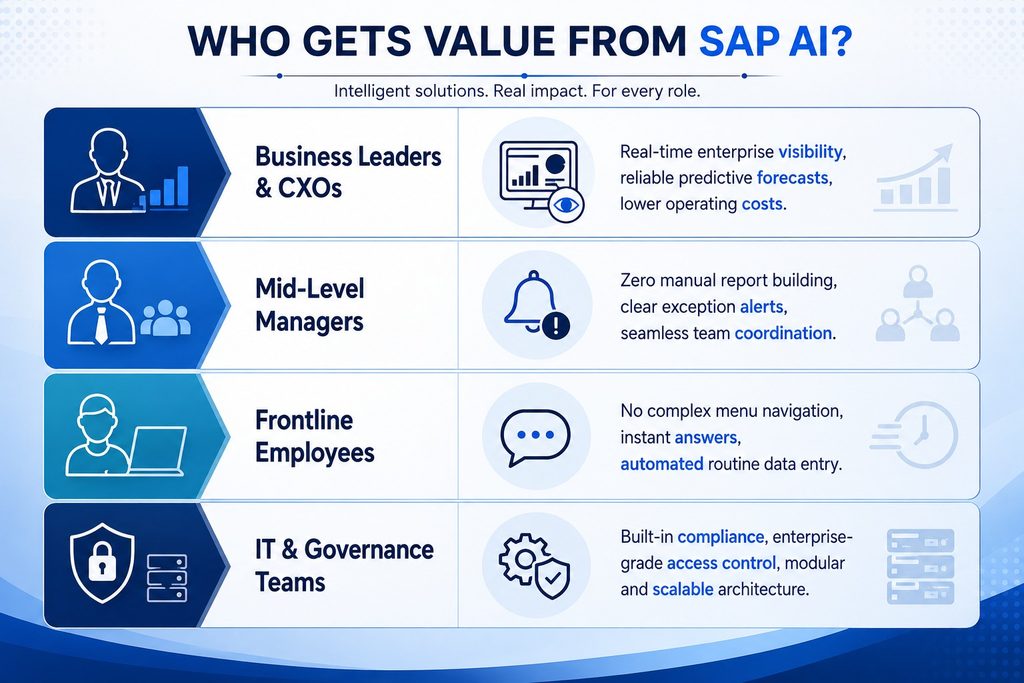
Business Owners and C-Suite Executives: Make strategic decisions using real-time
enterprise facts rather than outdated summaries prepared weeks ago.
- Operations and Departmental Managers: Eliminate manual report aggregation.
Focus management effort on addressing operational exceptions and process
bottlenecks. - Frontline Operational Staff: Complete daily workflows faster using conversational
interfaces without needing to learn complex software transaction codes. - IT and System Administrators: Deploy a single, governed AI framework that
eliminates the security risks of unmonitored shadow AI tools across departments.
Why Data Quality and Enterprise Governance Matter
A common misconception among business leaders is that adopting AI will instantly fix bad
data.
In reality, AI acts as a multiplier. If your underlying ERP data is inaccurate, duplicated, or
disorganized, AI will simply deliver inaccurate results faster.
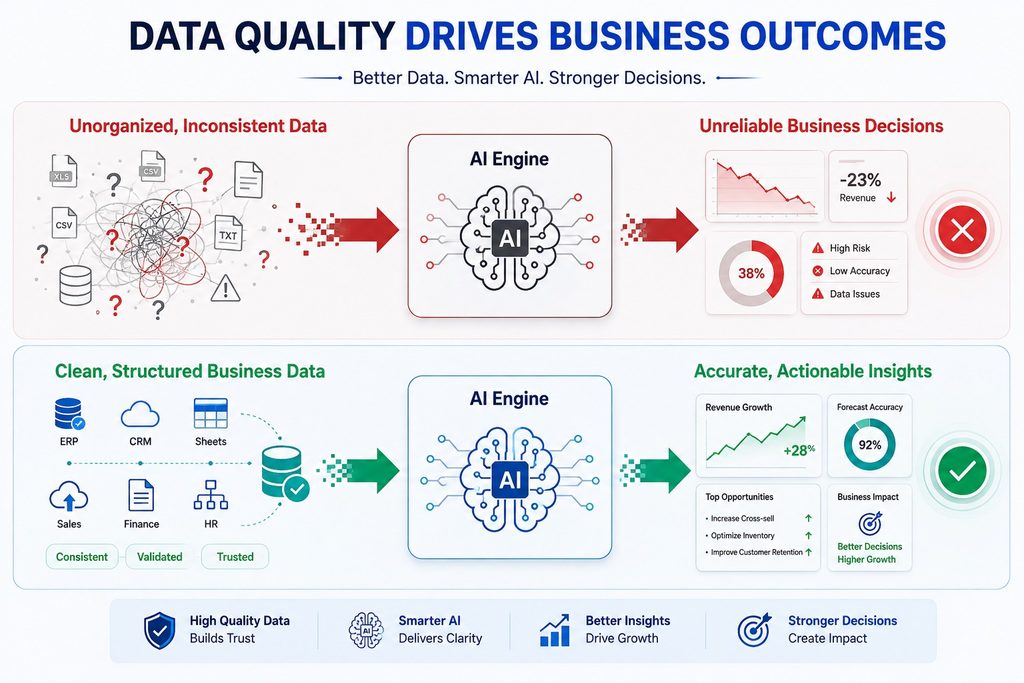
A successful SAP AI implementation requires three non-negotiable fundamentals:
- Data Quality & Standardization: Unifying customer, vendor, and product naming
conventions across all business units. - Permission & Access Architecture: Ensuring that role-based permissions strictly
control which data points the AI can access for specific users. - Human-in-the-Loop Safeguards: Keeping critical business decisions—such as high-
value purchase authorizations and employee changes—under direct human review and approval. - The Strategic Implementation Framework by Gitakshmi Technologies.
- Adopting enterprise AI should not be an expensive guessing game. Gitakshmi Technologies.
- helps organizations implement SAP AI through a clear, structured four-stage methodology:
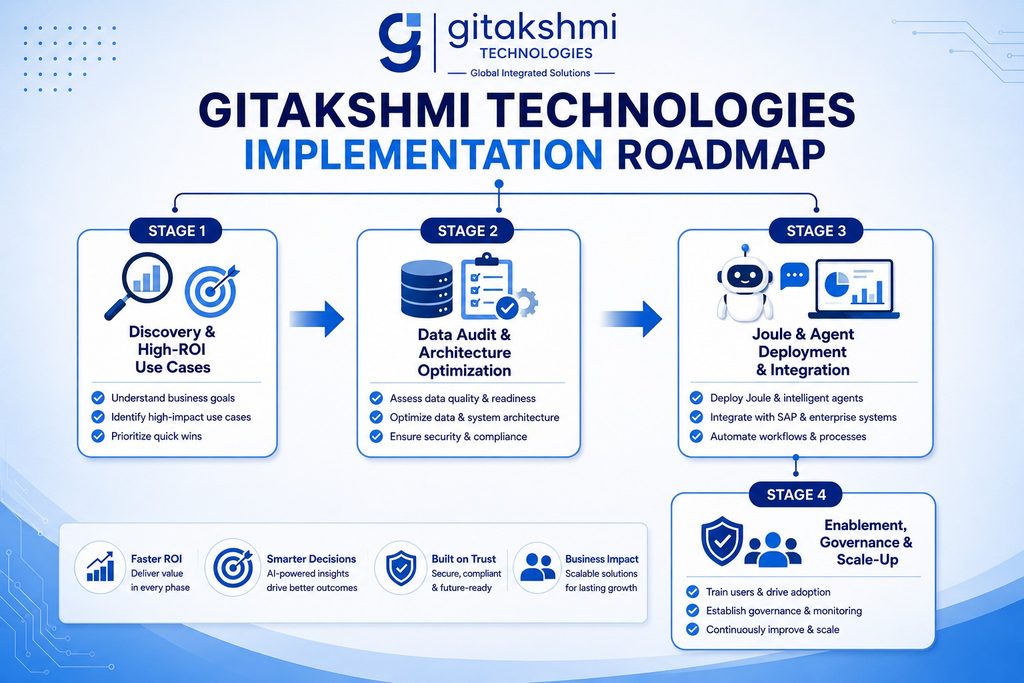
Stage 1: Process Discovery and ROI Assessment
We evaluate your existing workflows to identify the operational bottlenecks costing your
business the most time and money. Rather than applying AI everywhere at once, we target
high-impact, high-frequency processes first.
Stage 2: Data Audit and Architecture Optimization
We review your data structures, security hierarchies, and system integrations. We verify that
your master data records are clean, consistent, and ready for AI models to interpret
accurately.
Stage 3: Configuration, Joule Deployment, and Integration
We activate SAP Business AI components, configure Joule conversational interfaces for your
teams, and build custom Joule Agents using Joule Studio to handle your company’s
proprietary workflows.
Stage 4: User Enablement, Governance, and Scaling
We train your internal teams to interact effectively with conversational systems, implement
clear human-in-the-loop approval gates, and continuously optimize agent workflows as your
business expands.
Getting Started: 5 Practical Questions Before You Begin
Before investing in any enterprise AI solution, review these five diagnostic questions with
your leadership team:
- Which manual processes consume the most employee hours every week? Target
high-volume, highly repetitive tasks first. - Where are our managers constantly waiting for reports before making decisions?
These reporting bottlenecks represent your biggest productivity gains. - Is our master ERP data organized, or do we have duplicate records across
departments? Cleaning master records is the first step toward reliable intelligence. - Where must human judgment always remain mandatory? Identify the high-value or
sensitive checkpoints that must always require human sign-off. - Do we have the right implementation partner? Choose an expert partner like
Gitakshmi Technologies that understands both real-world business operations and
technical AI architecture.
Frequently Asked Questions (FAQs)
Q1: Is SAP AI only designed for multi-billion dollar enterprises?
No. While large multinationals utilize SAP AI across global supply chains, growing mid-market
enterprises frequently gain the fastest percentage gains in efficiency. Mid-sized companies
use SAP AI to automate routine back-office tasks, allowing them to scale operations without
dramatically increasing administrative headcount.
Q2: Will our proprietary company data be shared with external public AI models?
No. SAP Business AI operates within strict enterprise boundaries. Your financial ledgers,
customer records, and operational data are never shared with public foundational models or
used to train models for other organizations. All data handling strictly complies with global
standards including the EU AI Act and ISO/IEC 42001.
Q3: Do our employees need data science or coding skills to use Joule?
Not at all. Joule is built for everyday business users. Interacting with the system is as simple
as sending a chat message or typing a question in plain English.
Q4: How is SAP AI different from using standard RPA (Robotic Process Automation)?
RPA follows rigid, static rules (If A happens, do B). If an invoice format changes slightly or a
field is missing, RPA stops working and generates an error. SAP AI understands unstructured
information, adapts to variations in context, resolves minor discrepancies, and assists with
complex exception handling.
Conclusion:- The Move to an Intelligent Enterprise
The central goal of enterprise software has permanently changed.
For decades, companies asked their employees to spend valuable hours learning complex
software interfaces just to record what had already happened.
Today, intelligent systems are learning to understand human intent. They help teams analyze
real-time context, predict risks before they materialize, and take decisive action in seconds.
The future of business belongs to organizations that turn their operational data into
connected, everyday intelligence.
With the launch of advanced SAP AI solutions by Gitakshmi Technologies, your business has
the expertise, technology, and roadmap to lead this transformation.
Ready to Upgrade Your Business Operations?
Connect with the enterprise solutions team at Gitakshmi Technologies to schedule an
operational assessment and discover how SAP AI can drive measurable value across your
organization.