
Gitakshmi Technologies

Blog

Blog

Gitakshmi and Fortinet: A Simple Guide to the Best Cybersecurity for Your Business

Gitakshmi Announces Strategic Partnership with Fortinet to Strengthen Enterprise Cybersecurity In today’s fast-changing digital world, cybersecurity is no longer optional — it is essential. Businesses of every size face increasing cyber threats, from sophisticated data breaches to devastating ransomware attacks. To help organizations stay protected and future-ready, Gitakshmi proudly announces its official strategic partnership with Fortinet, a global leader in integrated and automated cybersecurity solutions. This partnership reflects Gitakshmi’s commitment to building secure, scalable, and intelligent digital infrastructures for enterprises across industries. By combining our consulting expertise with Fortinet’s world-class technology, we are redefining what it means to be “cyber-safe” in 2026. 1. A Strategic Partnership for the Modern Era Gitakshmi has always focused on delivering innovative IT and security solutions that drive business growth. However, as the digital landscape expands, so does the “Attack Surface.” Businesses are no longer just operating from a single office; they are in the cloud, on mobile devices, and across global branches. By partnering with Fortinet, we strengthen our ability to provide enterprise-grade cybersecurity solutions designed for modern hybrid environments. This includes protecting on-premise data centers, private cloud infrastructures, and public cloud platforms like AWS and Azure. This collaboration ensures our clients receive world-class protection backed by global expertise. 2. Why Fortinet? Fortinet is recognized worldwide as one of the most trusted cybersecurity companies. What makes Fortinet unique is its Security Fabric platform. Unlike other security providers that offer disconnected tools, Fortinet provides an integrated ecosystem where every tool “talks” to each other. Integrated Security: All components work together to provide 360-degree protection. Automated Detection: Systems find and stop threats instantly without waiting for human intervention. AI-Powered Intelligence: Uses artificial intelligence to learn about new viruses and hackers in real-time. 3. Why This Partnership Matters for Your Business Cyber threats are evolving every day, and traditional security methods are no longer enough to stop modern hackers. Today, organizations need more than just an antivirus; they need centralized visibility and real-time threat detection. By combining Fortinet’s technology with Gitakshmi’s consulting, deployment, and managed services expertise, businesses receive a complete cybersecurity ecosystem. We don’t just give you a product; we give you a strategy that ensures secure cloud connectivity and advanced compliance controls. 4. Our Fortinet-Powered Cybersecurity Services We have carefully designed our service portfolio to cover every possible vulnerability in your enterprise. 🔐 Advanced Network Security Solutions The network is the heart of your business. We design and implement secure network architectures using next-generation firewalls (NGFW). These are not simple filters; they include intrusion prevention systems and real-time monitoring to protect your enterprise network from even the most advanced cyber attacks. ☁️ Cloud Security & Multi-Cloud Protection As companies move to the cloud, security becomes more complex. Whether you use a public cloud, a hybrid setup, or a multi-cloud architecture, Gitakshmi ensures your data remains protected as it moves across different platforms. We bring “office-level” security to the internet. 💻 Endpoint Detection & Response (EDR) In the age of remote work, every laptop and mobile device is a target. Our EDR solutions monitor these endpoints in real time. If a device behaves suspiciously, the system automatically responds to the threat, isolating the device before the virus can spread to the company server. 🌍 Secure SD-WAN Deployment Branch offices need fast and secure connections. Our Secure SD-WAN deployment enables organizations to connect multiple locations efficiently while maintaining high performance and reducing costs. It’s the perfect blend of networking and security. 🛡 Zero Trust Network Access (ZTNA) The old rule of “trust but verify” is dead. We implement Zero Trust, which means **”never trust, always verify.”** ZTNA ensures that users are verified every single time they access a system, and access is limited strictly based on their job role. 📊 SOC & SIEM Services Our 24/7 Security Operations Center (SOC) provides continuous monitoring. Using SIEM (Security Information and Event Management) solutions, we collect and analyze security data from your entire business to detect threats early and provide rapid incident response. 5. Key Benefits for Enterprises When you choose the Gitakshmi-Fortinet alliance, you are investing in the long-term health of your company. The benefits go far beyond just “blocking viruses”: ✔ Strengthen Cyber Resilience: Your business can withstand and recover from attacks without losing data. ✔ Total Visibility: See exactly what is happening on your network from a single dashboard. ✔ Compliance Readiness: Meet industry regulations (like ISO, GDPR, or HIPAA) automatically with built-in reporting. ✔ Business Continuity: Ensure that your operations never stop, even if a threat is detected. 6. Building a Safer, Smarter Digital Future Technology is advancing rapidly, and so are cyber threats. To grow confidently, businesses must stay one step ahead of hackers. This partnership is not just about cybersecurity tools — it is about delivering trust, reliability, and long-term protection. Together, Gitakshmi and Fortinet are building secure digital ecosystems that empower enterprises to innovate. Whether you are migrating to the cloud or expanding your global team, we ensure your digital future is safe. Ready to Secure Your Enterprise? Don’t wait for a breach to happen. Let Gitakshmi help you secure your digital future with enterprise-grade solutions powered by Fortinet. Contact us today for a partnership inquiry or a full cybersecurity consultation. 🌐 Website: www.gitakshmitechnologies.com 📞 Phone: 079-49414862 Get Started Today Table of Contents All Categories Artificial Intelligence CMS Events & Conferences IOT Technologies Product Engineering Implementation Serivecs SAP Services Download PDF Gitakshmi Technologies may keep me informed via email or phone about its Products and Services.

Blog

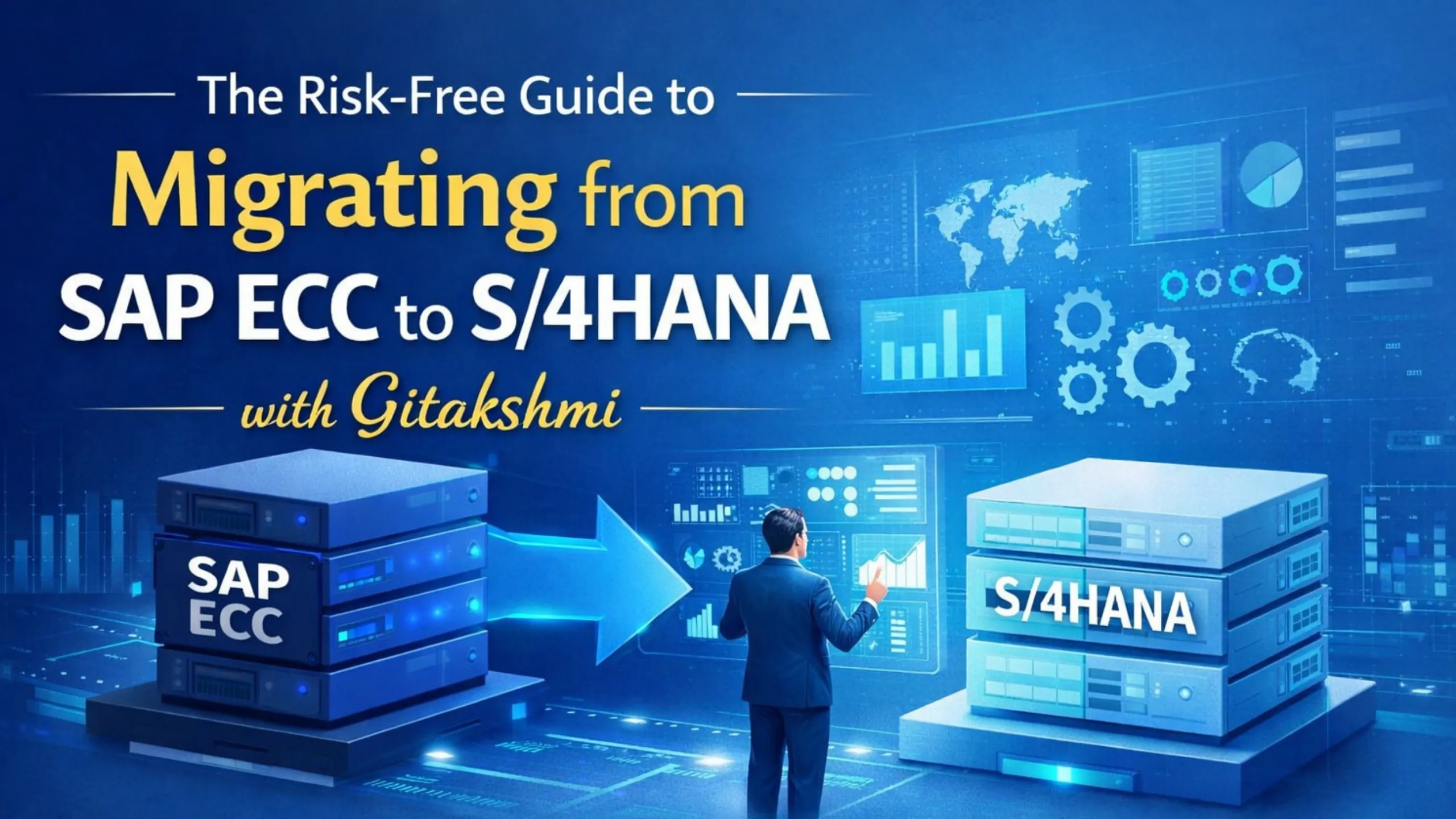
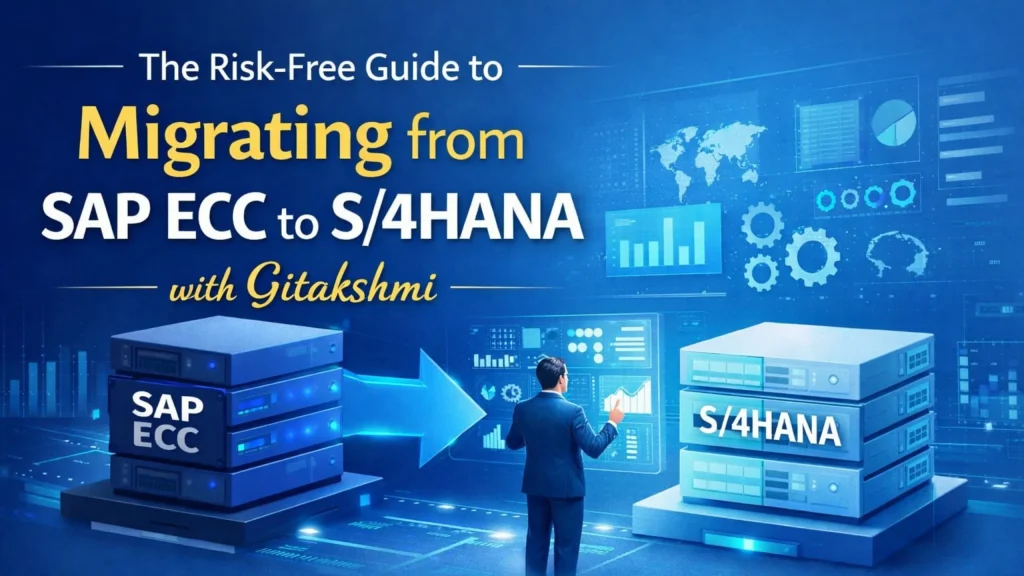
The Risk-Free Guide to Migrating from SAP ECC to S/4HANA with Gitakshmi

The Risk-Free Guide to Migrating from SAP ECC to S/4HANA with Gitakshmi 1 The 2027 Countdown: Why Staying on ECC is Risky For over a decade, SAP ECC has been the trusted engine for global businesses. However, with SAP officially announcing the end of mainstream maintenance for ECC in 2027, business leaders face a critical decision. Continuing with legacy ECC systems is a business risk. ⚠️ Security Vulnerabilities Without regular patches, your data becomes a target for cyber threats. ⚠️ Compliance Gaps Regulatory changes in tax and legal frameworks will no longer be automatically updated. ⚠️ Operational Cost Maintaining outdated hardware and paying for “Extended Support” is significantly more expensive. 2 Gitakshmi’s 4-Step Roadmap to S/4HANA A successful migration requires precision. We follow a rigorous 4-step framework to ensure Zero Data Loss. Phase 1: Discovery & Readiness We analyze your current system (landscape analysis) to understand hardware sizing, custom code compatibility, and business process dependencies. Phase 2: Intelligent Data Classification Migrating 100% of your data is unnecessary and costly. We help you categorize data: Data Type Definition Action Strategy 🔥 Hot Data Critical for daily ops Migrate to Memory 🌤️ Warm Data Needed for reporting Standard Storage ❄️ Cold Data Compliance archives Archive (Do Not Migrate) Phase 3: Data Cleansing Using advanced tools, we identify duplicates, fix formatting errors, and standardize data before it enters the new system. Phase 4: Execution & Cutover We execute with a clear “Rollback Strategy” ensuring your business operations are safe even in worst-case scenarios. 3 ROI Analysis: Turning Cost into Investment Many CFOs ask: “Why spend on migration?” The answer is ROI. S/4HANA is a new architecture. Feature Old World (SAP ECC) New World (SAP S/4HANA) Database Traditional (Disk-based, Slow) SAP HANA (In-Memory, Real-time) Processing Batch Jobs (Wait overnight) Live Insights (Instant decision making) User Interface Complex Screens (GUI) Modern Fiori Apps (Mobile Ready) Innovation Stagnant Built-in AI & Machine Learning 4 Essential Prerequisites Before You Start ✔ Unicode Compliance: Your ECC system must support Unicode to handle global character sets. ✔ Database Migration: You must move from legacy databases (Oracle/SQL) to SAP HANA. ✔ Custom Code Adaptation: Critical. Old Z-codes must be refactored to align with new standards. 5 Solving the Talent Crunch: Implementation + Staffing The #1 reason projects fail is lack of talent. Stop Juggling Vendors. We offer a 360° Migration Model: Challenge Traditional Multi-Vendor The Gitakshmi 360° Advantage Project Management Fragmented between vendors. Single Point of Ownership. Staffing Speed Weeks to hire a freelancer. Instant deployment of certified experts. Accountability Blame game on delays. End-to-End Responsibility. 6 Choosing Your Path There is no “one size fits all.” We help you select the strategy. Greenfield New Implementation Concept: Building a new house from scratch. Best For: Complex legacy systems; wanting to re-engineer processes. Brownfield System Conversion Concept: Renovating an existing house. Best For: Clean data; preserving existing workflows. Hybrid Selective Data Concept: A mix of both. Best For: Large enterprises needing specific historical data. 7 The Technical Execution Checklist ⚙ Maintenance Planner: Checks system requirements and download compatibility stacks. ⚙ Simplification Item Check: Identifies functionalities in ECC that have changed in S/4HANA. ⚙ SUM (Software Upgrade Manager): The core tool for database migration and software conversion. ⚙ Testing Phase: Functional, Performance, and UAT before the final Go-Live. 8 Beyond Go-Live: Ensuring Long-Term Success Migration is just the beginning. Once you are live, Gitakshmi ensures stability through: 🚀 Hyper-Care Support 🔄 Quarterly Innovation 👥 Continuous Staffing Ready to Future-Proof Your Business? Don’t wait until 2027. Start your risk-free assessment today. Contact Gitakshmi Technologies 👉 Table of Contents All Categories Artificial Intelligence CMS Events & Conferences IOT Technologies Product Engineering Implementation Serivecs SAP Services Download PDF Gitakshmi Technologies may keep me informed via email or phone about its Products and Services.

Blog

SAP Staffing S4HANA Migration Challenges

Why In-House Teams Struggle with S/4HANA Migration: The Case for Specialist SAP Staffing & Consulting Let’s be honest about a scenario playing out in corporate boardrooms right now. You have a loyal, hardworking internal IT team. They know your business inside out. They have kept your SAP ECC system running smoothly for years. So, when the decision comes to execute a SAP S/4HANA Migration, the natural thought is: “Why hire external SAP consultants? Our team can handle it.” This assumption is the single biggest reason why SAP projects go over budget. It’s not because your team isn’t capable. It’s because you are asking them to do two impossible things at once: Run the business and transform the business using complex new technologies. Here is why relying 100% on in-house resources is a risk—and how Gitakshmi Technologies, a premier SAP Consulting and Staffing Partner, bridges that gap. The “Keep the Lights On” Trap Your internal team has a day job. They are responsible for user support, fixing bugs, managing master data, and ensuring operational continuity.  When you add a massive SAP Implementation project on top of their daily workload, something has to give.  If they focus on the Project, daily support suffers.  If they focus on Support, the Migration gets delayed.  You cannot sprint a marathon. Expecting your team to work 14-hour days leads to burnout. This is where SAP Resource Augmentation becomes critical—bringing in temporary experts to handle the load.  The S/4HANA Skill Gap is Real Moving from SAP ECC to S/4HANA is not just an upgrade; it is a paradigm shift.  Old World: ABAP, GUI, RDBMS.  New World: ABAP on HANA, Fiori/UI5, SAP BTP, Cloud Integration.  Your internal team are experts in your current system. They are likely not experts in the new SAP Intelligent Enterprise stack yet. Expecting them to learn complex new technologies while architecting a critical migration creates technical debt. You need Certified SAP Consultants who have done this five, ten, or twenty times before.  The Value of External SAP Consulting Experts Internal teams are fantastic at knowing how things are done here. But transformation is about asking how things SHOULD be done.  When you only use internal resources, you often end up “lifting and shifting” old, inefficient processes. Top-tier SAP Implementation Partners bring a fresh perspective, challenging the status quo and introducing industry best practices (Best Practices) that your team might not be aware of.  The Gitakshmi Solution: Flexible SAP Staffing Models  At Gitakshmi Technologies, we don’t want to replace your IT team. We want to unleash them. We offer a Co-Sourcing Model that is the modern standard for Enterprise Resource Planning (ERP) success.  We Handle the Heavy Lifting: Our specialized consultants (Functional & Technical) handle the configuration, coding, and Data Migration.  Your Team Handles the Business Logic: Your internal team acts as the “Process Owners,” guiding us on business rules.  This is the winning formula. Your team doesn’t burn out, and the project stays on track.  Strategic Staffing for Critical Moments Sometimes, you don’t need a full consulting firm; you just need specific skills.  Need an SAP FICO Expert for finance closing?  Need SAP ABAP Developers for custom workflows?  Need an SAP MM/SD Consultant for logistics?  Gitakshmi Technologies provides On-Demand SAP Talent. We deploy pre-vetted, high-level consultants who plug into your team instantly.  Conclusion: Secure Your Project’s Future  Asking your internal team to handle a migration alone isn’t a sign of trust; it’s a business risk. Don’t let the “Hero Complex” sink your digital transformation.  Looking for SAP Staffing Services? Whether you need a full implementation squad or niche IT Staffing Solutions, we have the network to support you.  All Categories Artificial Intelligence CMS Events & Conferences IOT Technologies Product Engineering Implementation Serivecs SAP Services Download PDF Gitakshmi Technologies may keep me informed via email or phone about its Products and Services.
Blog

How SAP is Revolutionizing the Pharmaceutical Industry: Compliance, Safety, and Growth

Introduction In the pharmaceutical industry, making a mistake isn’t just about losing money—it’s about patient safety. Between strict FDA regulations, complex supply chains, and the constant fear of counterfeit drugs, running a pharma company feels like walking on a tightrope. So, how do top manufacturers sleep at night? They don’t rely on luck; they rely on SAP. Based on the latest insights from Gitakshmi Technologies, here is how SAP is acting as the ultimate booster shot for the pharmaceutical industry Compliance: Making the FDA Your Friend Let’s face it: Audits are scary. With regulations like FDA, GMP, and EU compliance constantly changing, manual documentation is a recipe for disaster. According to industry data, SAP removes this stress by:  Automating Validation: No more scrambling for papers during an audit.  Digital Documentation: Every step is recorded automatically, ensuring strict quality control at every stage.  The Gitakshmi Take: We help you set up SAP so that “Compliance” becomes a background process, not a panic attack.  Supply Chain: No More “Out of Stock” Nightmares Imagine a patient needs a critical medicine, but the raw material is stuck in transit. That’s a supply chain failure. SAP acts as the central nervous system of your logistics. It integrates procurement, inventory, and distribution into one screen. Reduce Wastage: Know exactly how much raw material you need. Timely Availability: Ensure medicines reach distributors before stock runs out. Manufacturing: Zero Error, Maximum Efficiency Pharmaceutical manufacturing is precise chemistry. One human error can ruin an entire batch. SAP streamlines production planning and batch management. By automating workflows, it drastically reduces human errors and ensures that your resources (machines and people) are used efficiently.  Manufacturing: Zero Error, Maximum Efficiency Counterfeit medicines are a global crisis. How do you prove your product is genuine? Serialization and Traceability. SAP enables real-time, end-to-end traceability of drugs. From the factory floor to the pharmacy shelf, you can track every single strip. This ensures compliance with serialization laws and enhances patient safety by preventing counterfeits from entering the chain.  Data-Driven Decisions: Predicting the Future Are you guessing how much to produce next month? Stop guessing. SAP provides real-time analytics and AI-driven forecasting. It gives you predictive insights so you can:  Adapt to market changes instantly.  Optimize where you spend your money.  Make informed decisions based on data, not gut feeling.  Conclusion: Is Your Pharma Business Ready for the Upgrade? The pharmaceutical industry is moving faster than ever. Old legacy systems cannot keep up with new regulations and market demands. You need a system that is as precise as the medicines you create.  At Gitakshmi Technologies, we specialize in implementing SAP solutions tailored for the unique challenges of the Pharma sector.  Ready to optimize your operations? Let’s ensure your technology is as advanced as your science.  All Categories Artificial Intelligence CMS Events & Conferences IOT Technologies Product Engineering Implementation Serivecs SAP Services Download PDF Gitakshmi Technologies may keep me informed via email or phone about its Products and Services.
Blog

Grow va Rise With SAP

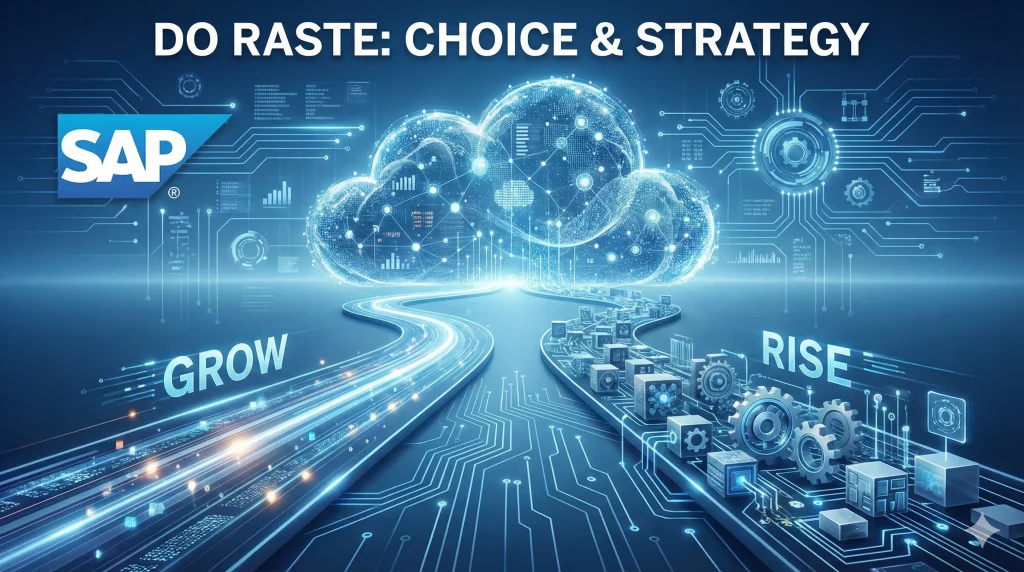
GROW vs. RISE with SAP: Which Cloud ERP Path is Right for Your Business? Navigating the world of SAP can sometimes feel like learning a new language. With the launch of GROW with SAP and RISE with SAP, businesses in Ahmedabad and across India are facing a common dilemma: Which path should we take? Both are powerful Cloud ERP solutions, but picking the wrong one is like trying to fit a truck engine into a compact car—it just won’t work efficiently. At Gitakshmi Technologies, we believe in simplifying technology. In this guide, we break down the critical differences between GROW and RISE to help you make a strategic decision for your organization. What is GROW with SAP? (The Speed & Agility Model) GROW with SAP is designed for speed. It is a commercial bundle built on SAP S/4HANA Cloud, Public Edition. Think of this as a “Ready-to-Move-In” apartment. The infrastructure is pre-built, the processes are standardized based on industry best practices, and you can move in quickly. Why Choose GROW? Rapid Deployment: Ideal for companies that want to Go-Live in weeks, not years. Innovation: You get the latest AI and automation updates automatically from SAP. Cost-Effective: Lower Total Cost of Ownership (TCO) with a predictable subscription model. Best For: Mid-sized businesses (SMBs), Startups, and Scale-ups in Gujarat who want to adopt standard processes without heavy IT management. Comparison: GROW vs. RISE with SAP Here is a quick cheat sheet to help you compare the two models: Feature GROW with SAP RISE with SAP Target Audience SMBs & Scale-ups Large Enterprises Cloud Edition Public Cloud (SaaS) Private Cloud Flexibility Low (Standard Process) High (Customizable) Speed Fast Implementation Strategic (Longer duration) IT Overhead Managed by SAP Managed by Partner/Customer The Verdict: Which One Should You Pick? The choice depends on your business strategy: Choose GROW if you are ready to adapt your business to SAP’s standard best practices. You want speed, simplicity, and minimal IT involvement. Choose RISE if your business processes are your competitive advantage. You need an ERP that bends to your rules, not the other way around. How Gitakshmi Technologies Can Help Choosing the software is just the first step. The real success lies in implementation. As a trusted SAP Service Provider in Ahmedabad, Gitakshmi Technologies acts as your strategic partner. Whether you need the agility of GROW or the power of RISE, we provide: Consulting: Honest assessment of which model fits your budget and goals. Implementation: Seamless deployment with minimal disruption. Support: Localized support with global standards. Ready to start your Cloud ERP journey? Don’t navigate this alone. [Link to Contact Us Page: Contact Gitakshmi Technologies] today for a free consultation. Corporate Presentation All Categories Artificial Intelligence CMS Events & Conferences IOT Technologies Product Engineering Implementation Serivecs SAP Services Quick Connect Gitakshmi Technologies may keep me informed via email or phone about its Products and Services.

Operate & Innovate with SAP Application Management Services
Blog

Operate & Innovate with SAP Application Management Services

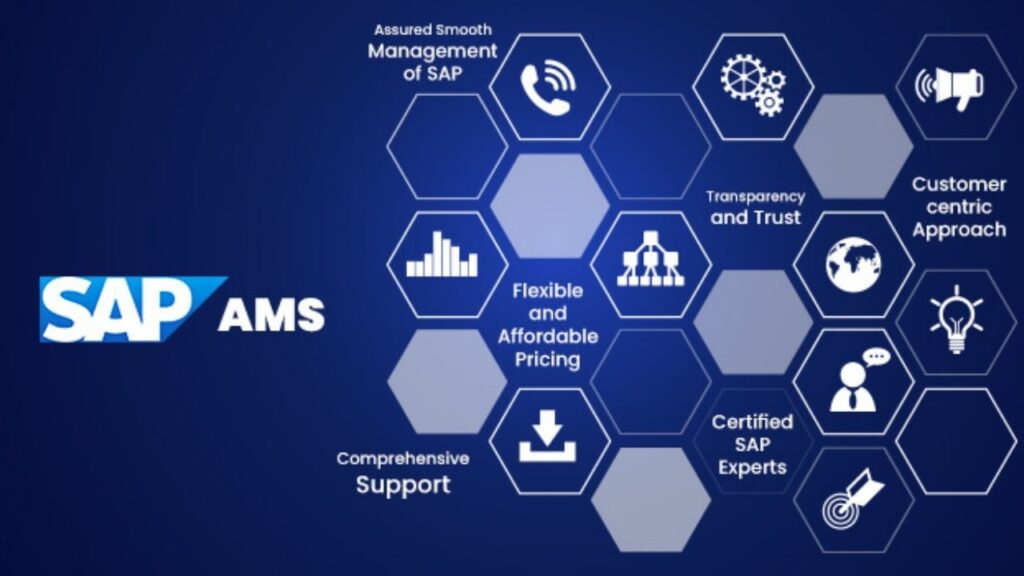
September 13, 2025 SAP Application Management Services has been reinventing how businesses run, and has enabled them to adapt quickly to the ever-changing business landscape. If you have already implemented SAP for your business, you know how well it redefined your business processes. While deploying SAP in your organization is the right step towards innovation and sustainability of your business, the journey doesn’t end there. It is merely a start in the right direction, and the actual work happens after introducing SAP into your company. After investing heavily in SAP applications, many companies fail to meet their business goals. The SAP applications ease your business processes but are complex in nature. With so much of the business riding on SAP after implementation, the stakes are high, and businesses find it hard to cope with the rising challenges. Rising service costs, lack of IT expertise, and constantly enhancing SAP application lifecycles demand deep domain expertise and robust governance. If the internal IT resources are always focused on resolving issues in the system, the business goals veer off track. To improve productivity, reduce costs and free up key IT resources — companies require a dedicated support system. Companies investing in SAP need clear value drivers to ensure SAP applications are running smoothly without any business disruptions. This is where the importance of a support system like Application Management Services (AMS) comes into the picture. An AMS aids you in taking full advantage of your SAP estate by running your SAP applications efficiently. SAP AMS support reduces risk, accelerates innovation, and addresses application lifecycle management — ensuring optimum ROI on your SAP investment through consistent support. That means, investing in AMS support is ideal to meet business expectations and enhance the quality of your SAP applications. The global Application Management Services market size was valued at $17,120 million in 2020 and is predicted to reach $94,786 million by 2030, registering a CAGR of 19.1% from 2021 to 2030 – Allied Market Research What is SAP Application Management Services (AMS)? SAP AMS is an outsourcing option where you delegate the ongoing support of your applications to an SAP service provider. The AMS support providers have vast IT experience and are proficient in maintaining SAP applications. They monitor your SAP system round the clock and release patches, fix bugs, and do everything possible to help your business run smoothly with minimal disruptions. While your AMS partner takes care of the day-to-day tasks, your internal IT team can focus on more strategic initiatives. Key benefits of choosing SAP AMS Proactive monitoring and diagnosis: Along with ensuring the right functioning of the applications, the AMS partner proactively monitors and diagnoses your SAP solution to prevent critical situations from arising. AMS looks at various aspects of your IT landscape including your business processes to identify early indications of potential issues and resolve them at the earliest. This actively mitigates your risk of facing critical issues. User operations and system efficiency: The users must be educated and trained professionally to meet expectations and improve business interactions. AMS experts closely work with the in-house IT team and prepare them for the new functional changes in the system. When the users have a deeper understanding of the new environment, it enhances the quality of operations. Evolving business requirements: The business environment is volatile in nature and requires constant modifications to stay ahead of the competition. The inputs and recommendations from the AMS partner to constantly improve SAP applications will help your business adapt quickly to changes. Your AMS partner, with their experience with similar businesses, can provide tailor-made recommendations on SAP solutions to help you achieve your business objectives and goals. Free up your internal IT resources: Having a dedicated team for SAP support will free up your internal IT resources for strategic initiatives and enables the business to do more. A well-designed application management process supports optimum development and testing. As a result, it reduces the time committed by the in-house team on tedious tasks and channels their focus on the core business agenda. Cost-effective solutions: Outsourcing application management services is a cost-effective way to manage your SAP applications. The global delivery models of your AMS partner offer an advantage of cost arbitrage due to lower overhead costs. The flexibility to ramp up or down resources and access to multiple technologies across all time zones increases productivity to a large extent. Automation for repetitive activities: Automation minimizes the amount of human interference in the workflows, analysis, and solutions. It reduces IT labor costs and improves the efficiency of the applications. Based on the requirement and landscape of the company, AMS will help decide and develop your automation roadmap and also deploy it. Continuous improvement: AMS support removes the complexity and provides configuration recommendations to get the most out of the existing architecture. AMS accelerates the adoption of innovations with a wide range of SAP tools and services to meet your business requirements for continuous growth and increased competitive advantage. Application malfunction and unforeseen events: Be it an application malfunction or a sudden hardware failure, AMS makes sure all the issues are sorted and provides future-ready solutions. SAP AMS provides all tools necessary to manage your applications and also ensure the timely release of updates without disturbing business operations. Support offered by your AMS partner Technical Support: Add-on functionality developments and enhancements Application integration Development services using standard ABAP, HANA, UI5, FIORI, WebDynpro, FPM, Workflow, Adobe Forms, IDOC/ EDI, PI/PO, SCI, BI/BW Development services using non-SAP technologies such as Angular, Node, Postgres etc. to help extend your core ERP application Support for SAP upgrades and migration to S/4 HANA Data migration Functional Support: Configuration of SAP modules and sub modules Business unit rollouts to different geographical locations Changes to business processes having cross-module impacts Month-end and year-end activities User training Functional support for SAP upgrades and migration to S/4 HANA System Administrative Services Proactive monitoring Patch updating Problem resolution Routine administrative activities Conclusion The ever-advancing SAP landscape is complex in

Cloud security strategy - The IT manager’s dilemma
Blog

Cloud security strategy – The IT manager’s dilemma

September 13, 2025 Cloud security strategy – The IT manager’s dilemma Data is central to everyone and everything Many companies move to the Cloud security strategy without fully considering the security implications. They may think a little about security, but when shifting operations to the cloud, it might not always get the attention it should: your cybersecurity approach and systems need to transform alongside your overall IT transformation and strategy. Today, organizations are home to vast piles of data, generated by an ever-growing number of connected devices and systems. And along with this massive growth in data naturally comes an increased risk of data breaches. To help address this, there is a growing number of security-related regulatory compliance initiatives. These include the EU’s Generation Data Protection Regulation (GDPR) and Gaia-X, a federation of European data infrastructure and service providers. Other schemes include the Payment Card Industry Data Security Standard (PCI DSS). You must remain continuously well informed about updates and modifications to any of these regulations to stay compliant and keep data secure. Using a responsibility assignment matrix (RACI) can be worthwhile to ensure clarity and help achieve your end goals. RACI represents “responsible, accountable, consulted and informed,” and it is an approach that can help the cloud provider and the customer to understand each other’s responsibilities and needs. No cloud vendor will be able to cover every angle from the beginning of an engagement, so organizations should take control and ask their cloud vendor the right questions. Those questions should cover crucial areas of focus such as: Privileged access Backup and recovery Patching and updates Constant monitoring SIEM solutions NOC / SOC Regulatory compliance Long-term viability Data location Investigation status Data segregation Availability Circumstances determine the approach Pre-COVID, you or your service provider’s IT managers typically had a clear plan and roadmap of how to transform the IT environment, what to do and when. There was a value in joint opportunity assessments and establishing the speed of change for your organization. I have seen businesses driving their IT strategy based on their business roadmap, where IT budgets were also established based on business demand or throughput. I call this phase the IT blueprinting phase.During COVID, the speed at which transformation could take place changed, with IT service design and strategy linked to employees working from home and changes in customer expectations. Joint opportunity assessments had to be conducted virtually due to lockdowns, meaning no face-to-face meetings. So, while the speed at which IT transformed was very fast, there was a shift from business leading IT to IT enabling business. IT budgets, which used to be allocated over five years, were brought forward as customers couldn’t operate within the time, agility and speed of market that COVID created. I refer to this situation as COVID transformation rather than digital transformation. During this time, we also saw an acceleration in thinking around zero-touch management through extreme automation, cloud-ready infrastructures, resilient network and enhanced cybersecurity.It meant companies did not have sufficient time to evaluate how a change in IT design or strategy would link to their overall IT blueprint with respect to the introduction of new SaaS or infrastructure moving from on-premises to cloud. Furthermore, companies did not have time to review the overall security posture. I call this phase “push-push,” rather than it being a time of companies implementing thinking based on a clear IT roadmap or blueprint.Post-COVID, there will be a shift towards a hybrid model, both in how IT facilitates future architecture and how business and IT will co-exist, with defined objectives meeting organizational goals. IT will need to focus on two important factors: first, cloud computing has evolved and has fast become even more flexible and reliable; and second, the massive influx of thousands of small-scale enterprises into the digital space, companies that had previously not been part of the equation. (Image source: www.itconductor.com) In summary: security first, cloud or no cloud Security must simply be built into your thinking from the start of your conversations with a cloud provider. Some organizations can worry about putting vital business functions such as IT or payment systems into the cloud because of security concerns. Still, it is important to remember that the challenge is not in the security of the cloud itself. In most cases, data breaches are usually a result of user error, not the cloud provider failing to enforce proper security policies and controls. If you implement robust security policies built on zero-trust principles and train your employees to follow those principles correctly, you should have a safe, secure cloud journey. Recommended for you 3 Ways to Unlock Operational Excellence with Business Analytics What is Infrastructure as Code and How Can You Leverage It? Corporate Presentation All Categories Artificial Intelligence CMS Events & Conferences IOT Technologies Product Engineering Implementation Serivecs SAP Services Quick Connect Gitakshmi Technologies may keep me informed via email or phone about its Products and Services.

SAP Service Cloud solution
Blog

SAP Service Cloud solution?

September 13, 2025 The latest SAP Service Cloud solution revolutionizes customer service by providing significant connections throughout the customer’s journey. It allows the entire organization to speed up the resolution of issues while fulfilling your promise to your customers and securing future expansion. The cloud-based platform we offer is among the main pillars that power SAP Business Technology Platform (SAP BTP) and has evolved into an integral part of our broad platform offerings instead of a standalone offering. Its powerful integration capability and extension are offered as services running in conjunction with SAP BTP. SAP on Google Cloud Google Cloud collaborates with SAP to offer SAP-certified infrastructure for all SAP systems. You can also choose Google Cloud to power SAP cloud-based services like SAP S/4HANA Cloud, SAP Ariba, SAP HANA Enterprise Cloud and SAP Cloud Platform. SAP Cloud Platform in itself. Google Cloud offers the right platform for building, deploying models and simplifying SAP solutions results. IDC discovered that customers who utilize Big Query for SAP saw an immediate reduction in the time required to generate data and insights while significantly reducing the cost of data storage. This BigQuery Connector that integrates with SAP provides our customers with an option: a quick, simple, cost-effective and massively scalable method to enable SAP data to be accessible in BigQuery. A few of the benefits that come with using SAP in the Google Cloud include: Google Cloud include: Google’s fiber-optic network offers a worldwide reliable, secure, and scalable basis that can be used for SAP deployments. It also allows you to optimize performance and cost. Automatization tools like Cloud Deployment Management and flexible deployment options can help you migrate your SAP environment into the cloud and move at your speed. A flexible virtualized infrastructure allows you to resize the machines you use as your company expands. You can increase the size of your infrastructure to accommodate the different demands of your business and avoid having to pay for services you don’t need. One of the giant SAP-certified virtual machines (VMs) available. Inbuilt features, for instance, Compute Engine’s live engine migration and auto restart, reduce the downtime required for infrastructure maintenance. Chances to be innovative with Google Cloud databases, data analytics, intelligent analytics, AI, machine learning, and the ability to integrate data. Today, SAP consulting is an exciting market for those who wish to establish their careers as Consultants. The critical thing to consider is to find the precise understanding and the right balance of time and plan. The primary reason behind its popularity in this area is the high amount of compensation that it provides. Get a Free Estimation or Talk to Our Business Manager! What Are The Types Of SAP HANA Consultants? SAP HANA Consulting is one of the most sought-after professions to come back into the economic climate. SAP is a term used to describe Systems, Applications & Products in Data Processing. It is a popular choice for the most efficient day-to-day business processes. It’s a well-known company within the Information Technology market, and the product has global recognition. Like the SAP products, SAP-certified specialists are highly sought-after. Consulting in Sales/Business, This Consultant focuses solely on winning projects completed by the clients. In general, the Consultant should not have much knowledge of SAP. Developer Consultant, The Consultant is in charge of creating Java/ABAP applications. SAP Functional Consultant,  This Consultant is accountable for personalizing SAP to meet the customers’ demands. They collaborate with the developers to design customized ABAP programs based on customers’ requirements. SAP Base Consultant,  This Consultant assists in installing, performing tuning and maintaining SAP servers and databases. They are among the top and most well-known consulting roles found within SAP HANA projects. Based on the initiative’s nature and scope, it’s possible to encounter different consulting positions, such as SAP Techno-Functional Consultants, SAP Security Consultants, etc. Business Intelligence (BI) is software that gives significance to an organization’s raw data. The raw data is cleaned and stored before being applied to business logic to make it beneficial to enterprise users to make more informed business choices. The information is presented in reports and can be shown in charts, tables, etc. These are efficient and easy to understand and take business decisions. Businesses collect data on suppliers, customers, and internal processes in all their business operations. Based on this data, employees from various departments such as Human Resources, Finance, Accounting, Marketing, Finance, etc. create work plans. Analytics Solutions Regarding SAP BI and database management solutions for data concern storage, transformation, and management. Analytics solutions are a collection of tools that provide access to data and enhance your business’s analytical capabilities. The simplest way to describe it is those analytics solutions are the front end of a BI-based system that offers reports, graphs and dashboards, and tools to discover analysts’ data. The analytics solutions platform comprises the following various products for business analysis and intelligence: Collaborative Enterprise Planning is an organizational planner, where every department can coordinate its actions and actions with the rest of the organization by relying on data-driven decision-making. This is like a Google Calendar on steroids for businesses planning financial and strategic choices. Predictive Analytics is software that lets you apply machine learning algorithms to forecast future patterns based on your data. Predictive analytics is built with pre-built algorithms and modeling tools that manage machine learning models. SAP Business Intelligence SAP Business Intelligence can be described as a fundamental product that comes with a variety of instruments for data access. This product is focused on tools for business analysis, reporting, and visualization of information. The tools within SAP BI are divided into two groups of users who are in the end. The first is business consumers (or the data consumer), a group of users that uses data to query, not involved in the databases’ inner structures. The second group is the data analyst (or an IT department). The users work within a database to create metadata, explore data and assist with queries. SAP BusinessObjects BI Suite is an

Business analytics for debt collection
Blog

Business analytics for debt collection

September 13, 2025 Leverage the power of business analytics for debt collection to revolutionize your financial recovery process. Advanced analytics helps segment delinquent accounts, prioritize outreach based on risk scoring, and uncover hidden patterns in payment behavior. With real-time dashboards and predictive models, your teams can improve collection strategies, optimize agent performance, and enhance customer satisfaction. Say goodbye to manual guesswork and hello to data-driven insights that boost efficiency, reduce operational costs, and ensure compliance. Whether you’re in banking, telecom, or retail, business analytics empowers your organization to recover more, faster—with smarter, scalable solutions that drive long-term results. Discover how analytics-driven collection strategies can help your business thrive in a competitive, fast-paced environment. Business analytics is one such strategic tool that can help leaders formulate highly effective strategies to reach consumers more effectively, predict consumer activity, and enhance overall business performance. Once you embed data intelligence into every workflow, process, and business application, you can fuel your collection operations for growth. In this blog, we will share some tips that will help you use business analytics as a tool to improve key performance indicators across your operations and achieve optimal productivity. 3 Ways to Unlock Operational Excellence with Business Analytics 1. Use historic data to your advantage By analyzing historic payment behavior, it is possible to identify risks associated with different consumer profiles and calculate contact effort for each account. A historical data trend goes further by anticipating how different consumer profiles will behave. If you use the historic data effectively to amend your collection strategy, you can optimize consumer contact costs by up to 30%. How to make this data work for you: 2. Segment consumers to formulate an effective outbound call strategy By segmenting the consumers according to specific criteria, you can speed up and tailor the communication as per their profile and optimize your debt collection strategy. Segmenting like-minded consumers into groups according to their payment behaviors can help you plan operations accordingly to achieve maximum resolutions in the shortest time-frame. How to make this data work for you: 3. Plan agent-consumer interactions based on data In legacy contact centers, agents are typically assigned based on pre-defined, static rules for all outbound debt-collection campaigns. This approach does not take advantage of current consumer profile information available and any past interaction data to connect the right agent to the right consumer. You can use business analytics to connect consumer behavior trends with your call center operations to make agent-consumer communications more effective.How to make this data work for you: Operationalizing Business Analytics for Growth If you’re struggling to interpret business data, it could be because you have too many disparate systems to integrate and many sources to pull your data from. We recently completed the same project, Even we have lists of scenarios, to understand that lists out a step-by-step process to use business analytics to unify your organization and drive operational efficiency. If you want to unlock the power of your business data to support better decision-making in your business, please reach us on info@gitakshmi.com and To Read more on Artificial Intelligence services. Corporate Presentation All Categories Artificial Intelligence CMS Events & Conferences IOT Technologies Product Engineering Implementation Serivecs SAP Services Quick Connect Gitakshmi Technologies may keep me informed via email or phone about its Products and Services.

Scroll to Top