
The Evolution of ABAP: Embracing RAP for Modern Enterprise Applications
The world of enterprise software is moving at a breakneck speed. For over three decades, ABAP (Advanced Business Application Programming) has been the powerhouse behind SAP’s success, enabling businesses to customize and build robust logic. However, as we shifted from the traditional R/3 systems to SAP S/4HANA and the Cloud, the way we develop applications had to evolve. The introduction of the ABAP RESTful Programming Model (RAP) marks a significant milestone in this journey. It is not just a new tool; it is a paradigm shift. RAP represents the “modern” way to build applications on the SAP Business Technology Platform (BTP) and S/4HANA. At Gitakshmi Technologies Pvt Ltd, we are at the forefront of this evolution, helping enterprises transition from legacy coding patterns to this structured, cloud-ready framework.
The Path to RAP: Why Did We Need an Evolution?
To understand why RAP is a game-changer, we must look at what came before it.
- Classic ABAP: This relied on Dynpros, ALV reports, and Module Pools. While powerful, it wasn’t designed for the web or mobile-first world.
- ABAP Programming Model for SAP Fiori: This was an intermediate step using SEGW (Gateway Service Builder) and BOPF (Business Object Processing Framework). It was functional but complex, requiring developers to jump between multiple tools and frameworks.
RAP solves these complexities. It provides a single, integrated, and standardized way to build OData services, whether you are building a simple “Read-Only” app or a complex “Transactional” system with full CRUD (Create, Read, Update, Delete) capabilities.
Understanding the Architecture of RAP
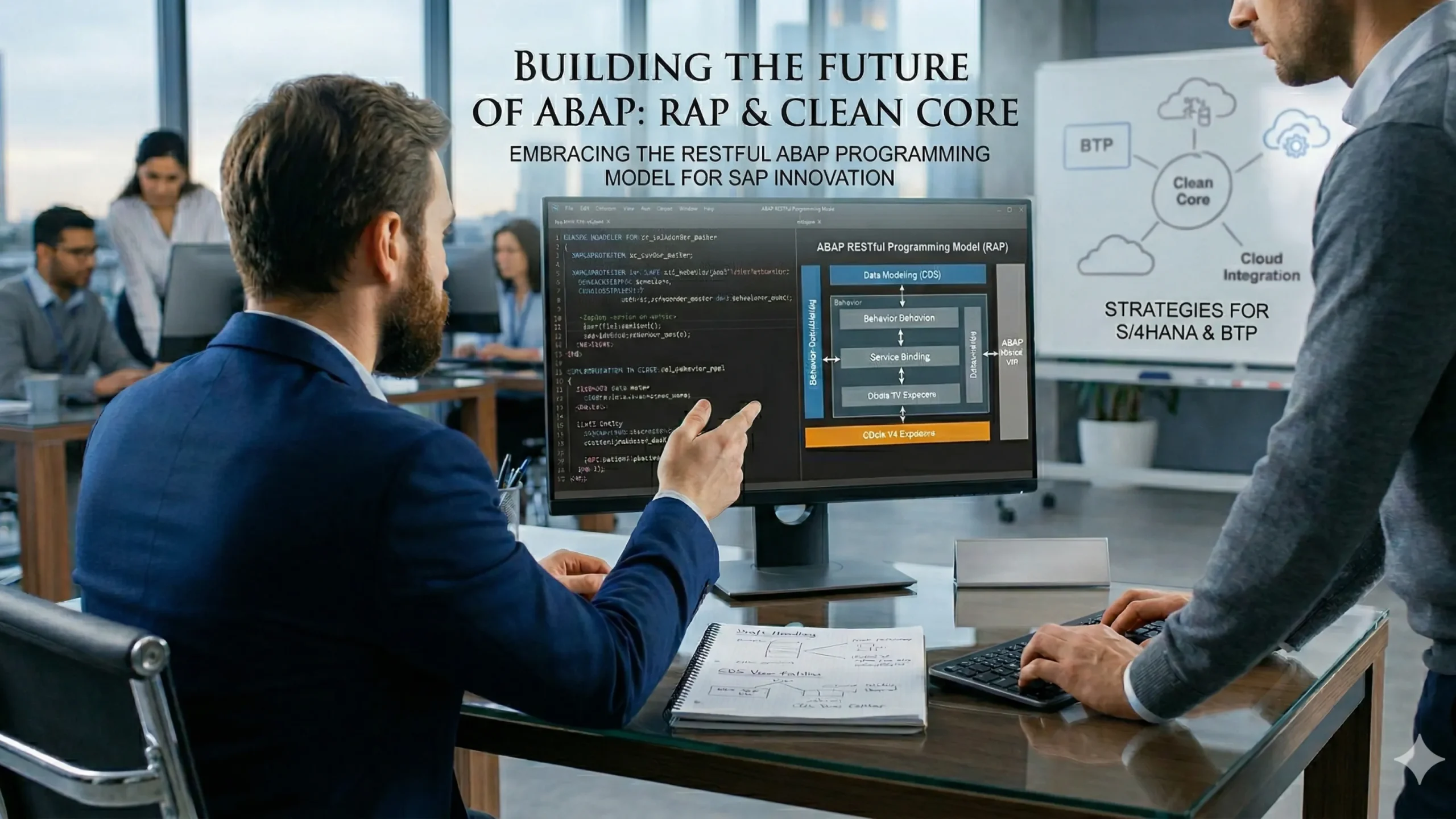
RAP is built on three core pillars that work in harmony to deliver a seamless developer and user experience.
- Data Modeling & Querying
The foundation of any RAP application is Core Data Services (CDS). Instead of just creating simple database tables, we create CDS Views. These are “semantically rich” models.
- What this means: The data model knows its own relationships. For example, a Sales Order view automatically knows how it links to Customer data.
- Annotations: In RAP, we use UI Annotations directly in the CDS. This tells the SAP Fiori frontend how to display the data (e.g., which field is a header, which is a chart, and which is a filter).
- Business Object (BO) Behavior
This is where the “logic” lives. In RAP, we separate the definition of behavior from its implementation.
- Behavior Definition (BDEF): Here, we define what the application can do. Can it delete a record? Can it trigger a special “Approve” action?
- Behavior Implementation (CBP): This is the actual ABAP code. It uses a new syntax called EML (Entity Manipulation Language). EML is designed specifically to talk to RAP business objects, making the code much cleaner and more readable than old-school SQL or Function Module calls.
- Service Provisioning
Once the data model and logic are ready, they need to be “exposed” to the outside world.
- Service Definition: You pick which parts of your model you want to share.
- Service Binding: You decide how to share it. Is it an OData V2 service for an older Fiori app? Or an OData V4 service for a modern, high-performance web application?
Key Features That Make RAP Superior
- Cloud Readiness (The “Steampunk” Factor)
RAP is the heart of SAP BTP ABAP Environment (also known as Project Steampunk). It allows developers to build applications in the cloud that are decoupled from the core ERP logic. This is crucial for “Keeping the Core Clean,” a strategy that makes future upgrades much easier for businesses.
- Built-in Draft Handling
One of the biggest pain points in web development is losing data if the browser crashes or the connection drops. RAP provides Built-in Draft Support. If a user starts filling out a form, RAP automatically saves a “draft” version in the database. The user can come back later and finish it without losing a single keystroke.
- Performance Optimization
Because RAP is built on top of SAP HANA, it uses “Push-Down” logic. Instead of bringing all the data into the ABAP layer to process it, RAP pushes the heavy lifting (filtering, sorting, calculations) down to the HANA database level. This results in lightning-fast response times, even with millions of records.
How RAP Benefits Modern Enterprises
Reduced Custom Coding
Traditionally, building a transactional Fiori app required thousands of lines of code. With RAP’s “Managed” scenario, SAP handles the standard Create, Update, and Delete operations automatically. Developers only need to write code for unique business logic, reducing development time by up to 50%.
Standardized Development
In the past, every developer had their own style of coding. RAP enforces a strict structure. This means that a project started by one team can easily be maintained or expanded by another. For a service provider like Gitakshmi Technologies Pvt Ltd, this standardization ensures that the solutions we deliver are of the highest professional quality and easy for our clients to manage.
Seamless Integration
Whether you are integrating with an external API, a legacy system, or a modern mobile app, RAP’s OData services are industry-standard. They work perfectly with SAP Fiori, but can also be consumed by non-SAP systems like React or Angular applications.
Each of these moves requires more than just “turning on” a new module. It involves data migration, user retraining, and often, a shift to the SAP Fiori user interface to unlock the true power of S/4HANA.
Why Gitakshmi Technologies Pvt Ltd is Your Partner in RAP Transition
Transitioning to RAP requires more than just knowing ABAP; it requires a deep understanding of S/4HANA architecture and Cloud-first principles.
At Gitakshmi Technologies Pvt Ltd, we have mastered:
- Greenfield Implementation: Building brand-new, high-performance apps using the RAP Managed scenario.
- Brownfield Migration: Taking your existing legacy ABAP logic and “wrapping” it in a RAP Unmanaged scenario so it can be used in modern Fiori apps.
- SAP BTP Strategy: Helping you leverage the Cloud to innovate without disrupting your core business processes.
Conclusion: The Future is RESTful
The evolution of ABAP is a journey toward simplicity, speed, and scalability. The RESTful ABAP Programming Model (RAP) is the destination. For any organization looking to stay competitive in the era of Digital Transformation, adopting RAP is no longer optional—it is a necessity.
As we continue to push the boundaries of what is possible with SAP technologies, Gitakshmi Technologies Pvt Ltd remains committed to delivering future-ready enterprise solutions. By embracing RAP and CDS, we ensure that our clients’ systems are not just running today’s business, but are ready for the innovations of tomorrow.